Wednesday, May 18, 2011

World Series of Birding!

On Saturday, birders from across the country converged on the state of New Jersey for what is probably the largest and most famous birding competition in the world- the World Series of Birding. In this admittedly insane contest, teams, consisting of 3 to 7 admittedly insane individuals, compete to try to see or hear the most species in a 24-hour period- from midnight to midnight. There are many levels of competition, and the playing field can be anywhere from a 17 foot circle (the "Big Stay") to the entire state. This year I participated in the madness for the first time, as captain of The Vagrants, a team sponsored by the New York State Young Birders Club. Myself and my intrepid teammates, Lewis Lolya and Nathaniel Hernandez birded in just Cape May County, at the southern tip of New Jersey, leaving the whole state division to the Razorbills, our marginally more insane friends, also sponsored by the NYS Young Birders Club.

I left for Cape May on Friday morning, getting a ride from Carena Pooth (an adult leader of the club and one of our drivers for the big day). Already scouting for birds down there were two of our other drivers and adult coordinators, Herb Thompson and Mary Batcheller (who took all the photos in this post), and Nathaniel, who had good news- they had heard a Cape May Warbler at the campground we were staying at. Five minutes later, we were all at the spot, listening to the high-pitched monotone notes of the warbler's song. From there, Nathaniel heard a Bay-breasted Warbler singing, and within minutes we were looking at two male Bay-breasted Warblers, another very nice and unexpected bird.

Planning out our route

With the birds seen, we began to plan our route for the next day. Planning and scouting are critical to any successful big day, because time is short, and it is a lot easier to stop quickly at a series of locations, quickly refind a bird you had seen while scouting, and leave, than it is to try to find new birds and string together locations on the run. Using a vast amount of scouting info gathered by Nathaniel, Herb, and Mary, as well as some given to us by other teams, and some from online listservs and ebird, we managed to lay down a rough route and schedule- Start at midnight at Jakes Landing for rails and other marsh birds calling in the night, then to Belleplain for owls and nightjars, then to Tuckahoe for more marsh birds. At dawn we wanted to be a Belleplain again for breeding songbirds, and after a series of stops for stakeout birds, including meadowlark, we would head to the beaches on the bayshore for shorebirds. After that we would go to the southern tip of the county, Cape May Island itself, for migrants, waterfowl, and other good birds. From there, we would work our way up the Atlantic coast of the county, stopping at Nummy Island for shorebirds and herons, and then a few more stakeout spots before finishing the day tracking down whatever night birds we had missed.
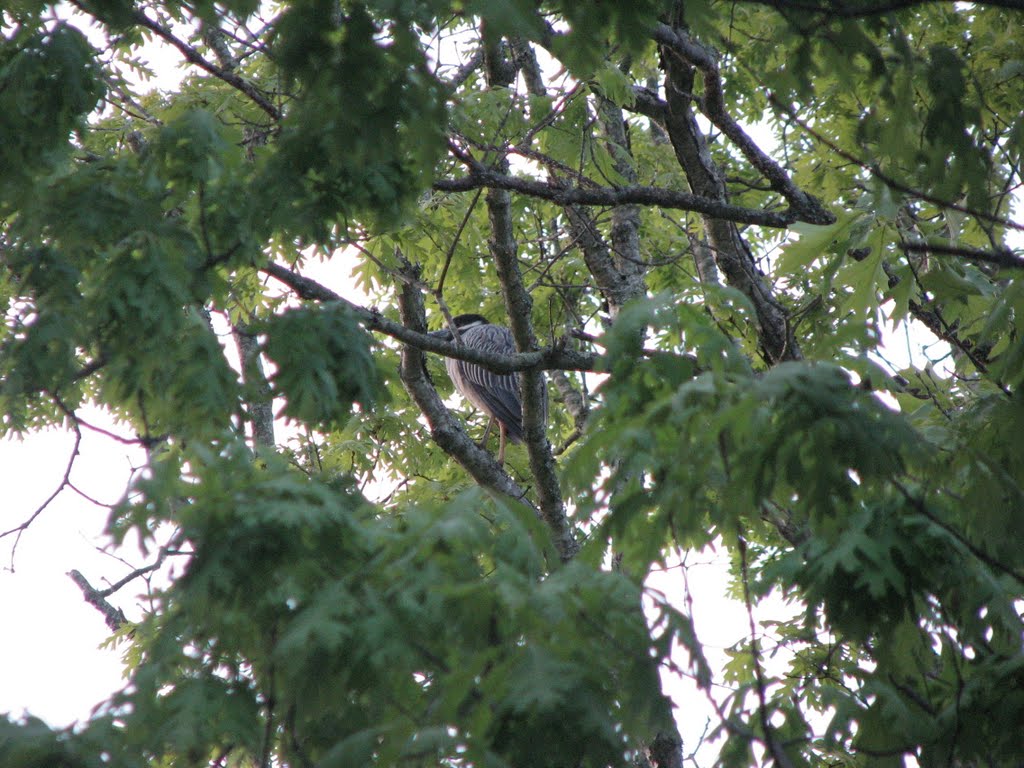
Yellow-crowned Night-Heron!
While we were doing that, Lewis arrived, and all of us ate some pizza before heading to bed for a quick nap before midnight came. While eating, two heron-like birds flew over. Their silhouettes were odd, and none of us could figure out what they were until they landed in a nearby tree- they were Yellow-crowned Night-Herons, another good bird.

After a brief rest, we woke up, packed the car, and departed on our mission- first stop, Jakes Landing. The World Series of Birding had begun!
The Vagrants (Nathaniel, Lewis, Eamon) prepare to set off

12:00 A.M., Jakes Landing- As our watches and phones switched from 11:59 to 12:00 we tallied our first bird- Willets, calling in the distance. Virginia Rail, Marsh Wren, and Seaside Sparrow quickly followed suit, each sounding off from across the dark marsh. A Canada Goose honked. We still needed at least one bird here, and finally a Clapper Rail called, a series of harsh, unmelodious keks. We had what we needed, and left with our checklist at 6 species. Caffeine consumption begins.

12:50 A.M., Belleplain- In the distance, but still very loud came the unmistakable whistled song of a Chuck-will's Widow. High-fives were exchanged. Soon we found more chucks, plus 3 Barred Owls hooting and a handful of Whip-poor-wills, also loudly whistling their songs. Spirits were high as we headed north.

~2:20 A.M., Tuckahoe- A Virginia Rail and a few Swamp Sparrows were vocalizing as we arrived, driving on a narrow dirt road past the ominous silhouettes of huge ships grounded at a marina, at Mosquito Landing in Tuckahoe. Even better was the Eastern Screech-Owl calling from the woods behind us. We were off to an excellent start. In the category of "birds that got away" was a mystery bird that flew unseen overhead, giving a chuckling call. It wasn't until 30 seconds later that I realized, "Wait, I bet that was a Least Bittern," but at that point it was impossible to be sure enough to count it. An adventurous detour on dirt roads through the center of the marsh was very fun, but did not net us any new birds.
A dark road in Tuckahoe- there was a Chuck-will's Widow calling very loudly here

~3:30 A.M., Jakes Landing- We decided to stop here again, because we had plenty of time before dawn. It was the last time the phrase "plenty of time" was used that day. A calling Great Horned Owl completed our sweep of all expected nocturnal birds, and made the stop very worthwhile.

5:00- 8:45 A.M., Belleplain- The dawn chorus at Belleplain was frustrating, and so was the lack of birds at many of our first few stops in the forest, but we eventually managed to nail down many of the necessary species- Yellow-throated Warbler, Acadian Flycatcher, Blue-gray Gnatcatcher, Pine Warbler, Wood Thrush, Prothonotary Warbler, Hooded Warbler, both tanagers, and finally Kentucky Warbler. Annoyingly, almost all of the birds were not visible, but I did see my lifer Acadian Flycatcher, and Yellow-throated Warbler and Summer Tanager added some color. Both waterthrushes were tough misses, though, and we had wasted a lot of time to get the birds we needed. Other locations in Belleplain were more sucessful, and we ticked Spotted Sandpiper, Eastern Phoebe, Kingbird and Orchard Oriole. We left Belleplain almost an hour behind schedule, but with less holes in the checklist than we had feared at first.
Listening for Songbirds at Belleplain

9:00 A.M, Woodbine- We had a tip that a field in Woodbine, just outside of Belleplain, was a good spot for Eastern Meadowlark, so we went there next. It was extremely successful, and we quickly added many species, including Black Vulture, Prairie Warbler, Brown Thrasher, Indigo Bunting, Killdeer, and, yes, Meadowlark. While driving to our next stop, we found Bald Eagle and Blue Grosbeak by the side of the road, two more good birds, and the latter a lifer for me.

~9:45 A.M., Jakes Landing- A quick stop at Jakes Landing in daylight for harrier and Saltmarsh Sparrow got us the harrier but not the sparrow. Nice looks at singing Seaside Sparrows and Marsh Wren were had, which was cool too.

~10:10 A.M., Beaver Swamp- We searched unsuccessfully for White-faced Ibis, but this stop got us Wood Duck and Glossy Ibis. Now even further behind schedule, unfortunately.

~10:30 A.M., Goshen CMBO- Back at Belleplain, Lewis and Nathaniel had both seen a hummingbird zip by, but I missed it. According to World Series of Birding rules, only 5% of your total can be birds seen by less than the whole team, so we stopped at the Goshen Nature Center to try to find a hummer at the feeders there. We didn't. but we got something better- a Pine Siskin, an excellent bird, quite unusual in Cape May in Spring. House Finch and Chimney Swift were bonuses.

~11:00 A.M., Reeds Beach- This stop was intended to get us shorebirds, and it did. Feeding on the beach were thousands of Laughing Gulls, and interspersed and flying by were some very nice and colorful Red Knots, along with Sanderling, Dunlin, Oystercatcher, Ruddy Turnstone and Short-billed Dowitcher. On the way out, I spotted a Tricolored Heron, but the others couldn't get on it before it vanished into the distance, so the bird did not count for our list. We had all we needed at this stop by the time the no-see-ums chased us away.
A tiny fraction of the thousands of Laughing Gulls present

12:00 P.M., "Secret" Campground Location- We stopped at our campground to pick up some stuff and to see if any of the birds from the day before were still around. They were. We quickly heard Cape May Warbler in the exact same spot, and then heard and found Bay-breasted too. Perhaps even better was the fly-by night-heron that Lewis relocated in a tree- a Yellow-crowned, and our 100th bird of the day. Our 101st bird? Pigeon. It felt like the end of a long day, but in reality we were only half finished. It was shaping up to be a very tiring day, but we expected that, and our spirits were high after getting such good birds.

12:30 P.M., Higbee Beach- Now almost two hours behind schedule, we arrived at Higbee at around noon. It was pretty dead, because the winds had been terrible for migrants the night before. We got Field Sparrow and Yellow Warbler, but resigned ourselves to missing such common migrants as Magnolia and Chestnut-sided Warblers. Michael Lolya, Lewis's father, met us here and brought sandwiches, the only real food we would eat all day- the rest was Dr. pepper (starting just after midnight), mountain dew (Starting at noon), wheat thins, twizzlers and double stuf oreos. On the way out, a Green Heron flew overhead.

~1:00 P.M., Cape May Point- A quick stop at the point brought us two new birds, both "least"- Least Sandpiper and Least Tern. Trying to make up time now, as we had to get to Nummy Island by 4 or so, so the tide would be in our favor. We cut out a few more planned stops on Cape Island.

~1:30 P.M., The Meadows- "The Meadows" was one stop we could not afford to cut, and it was very good that we didn't try. We nabbed Gadwall on the way out to the beach, and then, as we were climbing the dune, we had our most bizarre sighting of the day- a long-tailed bird flew by, and I thought "mockingbird," but we quickly realized that it was a Yellow-billed Cuckoo, flying inland from out over the beach. Where it came from we have no idea, but it seems like it had to have been flying out over the water before turning inland- there were no trees or anything remotely like cuckoo habitat in the direction from which it came. While overlooking the beach, we got Piping Plover in its nest and a fly-by Black Skimmer, both key birds. Walking back along the end of the trail, we picked up a lot of new birds in quick succession- Savannah Sparrow foraging on the edge of the marsh, Bank Swallow buzzing by with a group of other swallows, Lesser Yellowlegs taking off and calling, a Wilson's Snipe flying overhead, and, best of all, a distance Common Moorhen walking slowly through the reeds. We found a bird in with a group of short-billed dowitchers that looked like a good candidate for long-billed, but opted not to count it, as we could not be certain. We left the Meadows with our list quite a bit higher, and headed towards Nummy Island, now more or less on schedule because of the skipped stops and short time spent at Higbee.
Cuckoo, Skimmer, and Piping Plover checked off, we pause for a photo with the Lighthouse

3:45 P.M., Wetlands Institute- We pulled up to this visitor center/museum, and quickly checked off the two "semipalmated" birds- plover and sandpiper. I also saw a Clapper Rail run across the marsh before disappearing, as is their habit to do. A tally of our list as we headed out came to 124, and we set a goal to try to get to at least 130 by the end of the day.

4:15 P.M., Nummy Island- We met my Dad here, and started scanning the extensive marsh, which was filled with birds, for ones we had not already seen, while pondering how a large suit of armor found itself perched on a hill across the marsh from us. Other teams found it too during scouting- this is what it looked like from where we were. Odd, right? If not for the fact that I had already seen that photo, I would have assumed I was hallucinating from lack of sleep. Brant, Black-bellied Plover, and Whimbrel were the first new birds we added. A Little Blue Heron flew by, our 128th bird. Then another team shouted "Black-crowned Night-Heron," and we simply looked in the direction they were looking- totally not cheating, it was their fault for being so loud (Thanks Chippers!). I then spotted a more distant Night-Heron without any inadvertent assistance from other teams, if the legitimacy of the previous bird was questioned. When a pair of Peregrine Falcons flew by a few seconds later, we were rather quiet about it, but inwardly we celebrated our 130th species of the day. A quick scan yielded another Clapper Rail and a Tricolored Heron that everyone saw, another new bird. Possibilities for new birds exhausted, and rather exhausted ourselves, we departed from Nummy Island with a new goal of 135 species.

~5:20 P.M., Random Parking Lot- We now had an extra car, so we left one in a parking lot. While a few people were in the bathroom, Nathaniel, Lewis, and I decided to scan the ocean for gannets, and were quickly successful, finding at least 5 of the large seabirds.

~6:00 P.M., East Shore Nursing Home- A stakeout spot for Cattle Egret, but we couldn't find any.

~6:30 P.M., Tamerlane Campgrounds- Another stakeout, this time for Red-headed Woodpecker. Similarly unsucessful. We were running out of daylight and new birds to shoot for.
Seaducks were seen at Sea Isle

~7:00 P.M., Sea Isle City- A mixed flock of seaducks held Common Eider, Surf Scoter, and Black Scoter, the former two new birds for the day. A peregrine was fun to watch overhead, both hanging suspended in the wind, and then turning around and rocketing down the beach with the wind at its back. The surf was too rough to get Purple Sandpiper on the jetty. Light was fading, and there was a light rain. "Tired" or even "Exhausted" would be an understatement at this point. No chance for any new day birds, and our total stood at 134. We were going to try for night birds, but we didn't have high hopes- the only ones that we hadn't heard the night before were the extremely elusive Black Rail and Least Bittern.
Peregrine overhead

~9:00P.M., Tuckahoe- We were falling asleep on our feet, quite literally beginning to hallucinate birds, and with the wind and rain the rail and bittern seemed impossible, so we decided to call it a day and head to the finish line. Our last bird was a Virginia Rail calling in the distance.
Barely awake- notice the vacant stares.

12:00 A.M., Finish Line- Our final total was 134 species, which was quite good for a day with very few migrants. For comparative purposes, we were 2nd out of the four youth teams that did Cape May County (The team that beat us were the Chippers, whose night-heron we "stole" at Nummy Island), and 6th out of the the 13 total teams that did Cape May, including the very competitive adult teams. The winning team in Cape May was the Cornell Redheads, who found 163 species. The Razorbills found 193 species, taking home the gold in the Youth division, and putting them third overall, an excellent showing for a youth team. The overall competitive was won by the Lagerhead Shrikes, who found 221 species across the state to win the coveted Urner Stone Cup.The Siskin that we found was the first to be reported by any team in the state, which was cool.
The Finish Line, obviously
Looking over the list, a few things are very clear. First, we saw a lot of birds, and there were quite a few really good ones- owls, Chuck-will's Widow, Siskin, Cape May and Bay-breasted Warblers, Yellow-crowned Night-Heron, and many more. Secondly, and perhaps even more obvious are our misses- warblers feature prominently, particularly Magnolia, Parula, Chestnut-sided, Yellow-rumped (!), both Black-throated warblers, and the waterthrushes. Woodpeckers are practically nonexistent on the checklist- we missed Hairy, Sapsucker, and even Flicker. Perhaps worst of all was the fact that we did not see a single Red-tailed Hawk all day (well, actually, flicker might be worse. But still...). Even so, everyone misses some birds, and we were definitely happy with our final tally. At least we finally found that pigeon- now that would have been an embarrassing miss.
Looking over the list

All in all, it was a awesome, really fun day. We saw a lot of great birds, and came us with a respectable total for our first year competing. Just wait until next year...

Wednesday, April 20, 2011

Some Good April Migration Birding

I'm off from school this week, so the past 3 days I birded some spots in Westchester and the Bronx, seeing good numbers and diversity of migrants for this early date. In total, I saw 6 warbler species and plenty of other nice birds.

On Sunday, I went to the Marshlands Conservancy, probably my favorite local birding spot. There hadn't been that much migration the previous night, but there were still some birds around. The highlight was a pair of Great Horned Owls- a chick and an adult, at a nest. I got very good looks at both. Down at the marsh, there were lots of tree swallows flying around, as well as a single Great Egret, a pair of Osprey, and some common waterfowl. Heading back up along the field, I was surprised to find a nice male American Kestrel flying around and perching on the kestrel box in the field- hopefully they will nest there, as a female had been seen nearby the day before. I added 4 species to my Westchester year list, which I actually care about this year, because of the Ebirdathon.

On Monday, I biked early to Glenwood Lake, which is really a small pond in the midst of a residential area with some trees around it, but is still the best spring birding spot in biking distance, by far. I figure it's due for a nice rarity, but that day wasn't the day, I guess. Still, it was an excellent morning of birding- I arrive, locked my bike, looked up, and found Yellow Warbler, Ruby-crowned Kinglet, Black-and-white Warbler, and Blue-headed Vireo in quick succession. About a quarter of the way around the lake, I ran into a largish flock of warblers. It was mostly Yellow-rumps, but with plenty of palms and a few pine warblers too. Also there were both kinglets, a Brown Creeper, a Hairy Woodpecker, a few more vireos, and a Blue-Gray Gnatcatcher. Not bad! From there I biked on to Nature Study Woods, a large area of wet woods along the Hutchinson River Parkway. It was much quieter there, but there were lots of woodpeckers (all 4 common species), and 4 of the 5 warblers I had seen earlier. Also nice were plenty of Hermit Thrushes, a pair of Wood Ducks, another creeper, a House Wren, and an Eastern Phoebe. In total, I added 11 species to my ebirdathon list.

Yesterday I decided to chase the Prothonotary Warbler at the NY Botanical Gardens, and to see if there were any other migrants around. I got there by bus a little after ten, which is when the gardens open. I headed to twin lakes, the area where the bird had been seen, spotting a turkey and a fly-over group of four Monk Parakeets on the way over. I got to twin lakes, where there were lots of butterbutts (yellow-rumped warblers) in evidence, as well as palm and pine warblers, and a couple of Ruby-crowned Kinglets and Gnatcatchers. Over the lake itself were lots of Northern Rough-winged Swallows and a couple Barn Swallows, both my first of the year. The birds were actually very similar in numbers and diversity to the day before, with one big exception. Walking the trail around one of the lakes, I spotted the male Prothonotary Warbler foraging low in the branches of a tree that had fallen into the lake. I got fairly long and very good look at the brilliant gold bird, before it flew a little ways along the coast and disappeared. Awesome bird! If you don't know what a Prothonotary Warbler looks like, this photo (not mine, obviously) will explain why seeing one is such a big deal. I've actually had pretty good luck with Prothonotaries- the first rare bird that I found myself was one at Greenwich Audubon 2 years ago, then I saw one in Carara NP in Costa Rica last year, and of course the extremely tame bird in front of the New York Public Library last winter- making me 4 for 4! I spent the rest of the morning birding the forest at the Botanical Gardens, with Black-and-White Warbler, Blue-headed Vireo, and tons of Gnatcatchers the highlights.

I'm not birding today, but hopefully migration will be good tonight, and I can head to Central Park tomorrow. Good Birding, and Happy Spring!

Thursday, March 24, 2011

Birding Florida 2011


I went to Orlando a little more than a week ago. While the trip was centered around Disney, of course, I was able to fit in some birding, and ended up with 3 lifers, and a lot of great birds. It was a welcome break from the fairly slow birding in New York in March, as well as from the cold.

Day 1 (Saturday, March 11th)- Got to Orlando at 10:30 or so, and started to see some of the familiar common Floridian birds- Boat-tailed Grackle, Tree Swallows, Turkey Vultures, and Herons and Egrets. On the drive from the airport to a waterpark, I had my first very nice sighting of the trip. While we were stopped at a toll, I noticed what I first though was a Little Blue Heron flying with a Snowy Egret. However, I soon realized that it was much too large to be a Little Blue, because it was noticably bigger than the snowy. Tricolored was eliminated by the lack of white underparts, and the bicolored bill and rusty neck sealed the id- it was a Reddish Egret, an unusual (though not unheard-of) bird in the area. At the waterpark I picked up a few more birds- Black Vulture, White Ibis, Bald Eagle, and Yellow-bellied Sapsucker.

Day 2 (Sunday, March 12th)- Headed to Animal Kingdom in Disney early. After making sure that the spoonbills were captive and not wild, I turned to watching the abundant white ibis. There were lots of birds overhead, and I picked out a Purple Martin overhead. There was a large cluster of vultures, and with them was a smaller bird- a dark buteo, with distinctive white patches on the underside of the wings. Short-tailed Hawk! I had been hoping for one on this trip, and had somehow found one, almost purely by chance. Later in the day, a Pileated Woodpecker flew by our car in a parking lot, and I found the first of many Palm Warblers.

Day 3 (Monday, March 13th)- Much of this day was spent observing the unprecedented invasion of northern owls into the Orlando area. While at The Wizarding World of Harry Potter, I found large numbers of snowy, great horned, barn, great gray owls, on a scale never before recorded in Florida. Additionally, there were multiple European Eagle Owls, which, if I am not mistaken, represent the first six records of this species in North America. Also of note was a presumed hybrid owl- looking like an abnormally large Great Horned Owl, it gave a Barred Owl call consistently and clearly. The reasoning for the concentration of owls is unknown, but it might have something to do with the fake snow covering nearby buildings- presumably all Snowy and Great Grey owls in Florida would be attracted to this spot, as it resembles the snowy north.
Perhaps this building has something to do with it?
Day 4- (Tuesday, March 14th)- I spent the whole day at Magic Kingdom and Epcot, which both had more birds than expected. Nice sightings were Cattle Egrets at the entrance to Magic Kingdom, and Brown Pelican, Bald Eagle, Osprey, and Mottled Duck at also around Magic Kingdom. Epcot is centered on a lake, which was filled with cormorants, anhingas, coots, and grebes. Much of the area around orlando is like this- there are tons of small ponds and water-filled ditches, and each of them has a handfull of nice birds in it- herons, egrets, coots, ibis, grebes, or moorhens, usually.

Day 5 (Wednesday, March 15th)- Our last day in Florida, and the only one with any real birding planned. The destination that I had picked was Brinson Park, on Lake Toho in Kissimmee, about 20 minutes south of our hotel. The spot is known as a reliable location for Snail Kites and other nice waterbirds. It was a good sign when we pulled up in the parking lot, and the first thing we saw was a pair of Limpkins, one carrying a snail.
Panorama of Lake Toho. Click to see the whole photo.
Birds were everywhere- there were hundreds of coots, at least a half-dozen Limpkins, a big cloud of Tree Swallows, more pied-billed grebes than I had ever seen before, multiple moorhens and anhingas, and more birds showed up at every scan. I quickly found some new herons for the trip list- Little Blue and Tricolored. Even better were a pair of Sandhill Cranes that flew by, quickly joined by a few more cranes.
Moorhen
 I started scanning the bushes on the north shore of the lake, because I had read that Snail Kites sometimes perched at the top of low vegetation near lakes. This looked like pretty perfect Snail Kite habitat to me, but the distance complicated the search- without a scope, I saw a raptor-like profile in a tree a few times, only to realize that it was an anhinga, which looks oddly nothing like a cormorant when perched at a distance. With its upright posture and long banded tail, it looks almost like a Cooper's Hawk, until you see the head and neck, when the bird's identity becomes obvious.

While searching, I spotted a flock of duck-like birds flying by, and quickly realized that with their long necks and white wing stripes, they were Black-bellied Whistling-Ducks, nice birds and my first outside of Costa Rica. Snail Kites were not in evidence, so I went back to watching the numerous and tame Limpkins, very cool birds whose abundance at Lake Toho belies their overall status- they are found in the US only in Florida, and are often wary and secretive. Here they were walking in full view beside a major road.

Glancing up, I spotted a large raptor flying over the lake closer to the opposite shore. Slow, floppy wingbeats? Check. Overall grey coloration? Yup. Distinctive tail pattern and white rump? Definitely. Snail Kite? Yes!! It flew down and perched on one of the bushes I had searched earlier, and I got a good look at it before it flew away and disappeared, only to reappear not long afterwards with another snail kite in tow, the second bird being either a female or an immature. Awesome. Great bird, great experience.
Snail Kite Paradise 
After the kites flew out of sight, I checked the trees in the small park, finding some migrants- Yellow-rumped and Palm Warblers, a Savannah Sparrow, as well as another nice Floridian bird, a Eurasian Collared Dove. They will probably we everywhere in a decade or two, but for now this exotic is still mostly restricted to the southeast. We had to leave to catch our flight, but a Forster's Tern and a Green Heron wrapped up the sightings at Lake Toho. In all, we had been there for barely over an hour, but had seen enough good birds for an entire trip.
Collared Dove
And to top it all off, I got my lifer Loggerhead Shrike on the way to the airport.

Friday, March 11, 2011

Off to Florida!

I leave for Orlando tomorrow for 5 days tomorrow morning. While much of the time will be spent in Disney, I will try to bird as much as possible. I definitely have some photos and posts when I get back. Good Birding!
Target Bird- Snail Kite (photo from wikipedia)

Tuesday, March 1, 2011

Bird Quiz #3- Crossley Guide Edition

I just got my copy of the new Crossley ID Guide, which I really like, and decided to do something a bit different for this week's quiz.

It is based on the birding game in which one person reads lines out of a field guide and the other birders try to guess the bird. Generally this is done with the Sibley Guide, but it seems like it would be even more fun with the Crossley Guide, which has much more descriptive and colorful text (and much more text in general). Of course, the colorful plates are the obvious thing when you look at the guide, but the text is great too. There are five birds in this quiz, each with excerpts from the description in the guide.

Have fun, and leave your guesses in the comments. If necessary, I will add new clues later in the week.

1) A real tank...killer-like thick bill...overall impression is clean and bold...if in doubt, look at that bill...younger birds' contrasting plumage is neat and fairly distinctive.

2) Fluttering "butterfly-like"...often partially opens wings and spreads tail... then it's off again... shape and color pattern make this an easy bird to id overhead.

3)Fairly common breeder, scarcer in east... has a shuffling gait... seems to walk with feet back and chest thrust forward... commonly sings from barbed wire fences... large and particularly fat... distinctive head pattern.

4)Seems to embrace bad weather...Male is a real stunner...appears gentle...often seen standing on rocks...stubby bill on small head.

5) Simply beautiful; the epitome of grace (it would have been at home in the movie 'Avatar'). Flies just above the treeline, never in a hurry, but deceptively fast. Loves warm weather.