Tuesday, May 7, 2013

Camp Chiricahua Part 3-- The Chiricahuas

Cave Creek Canyon.
Wow, it's been a long time since I last posted. Sorry about that. I've finally gotten around to writing the lasts posts about Camp Chiricahua, and even though this is now more than 6 months old, I figured I'd post it anyway. This one's about our time in the Chiricahuas, then I'll very soon do one about the Huachucas, then some more somewhat more recent stuff (including my report on my trip to Hawaii) will be coming up soon (hopefully). As before, life birds are listed here in bold.

So when I left off the camp had arrived at Portal and settled into the Cave Creek Ranch, in the shadow of the walls of majestic Cave Creek Canyon. It was an incredible spot, with Blue-throated Hummingbirds, Dusky-capped Flycatchers, Magnificent Hummingbirds, Mexican Jays, and Acorn Woodpeckers all abundant just outside our rooms. Our first morning in the Chiricahuas was Friday, the third of August, and we had some great birding ahead of us.

We started in the grassland habitat east of and below Portal, near the town of Rodeo, New Mexico, and along State Line Road. There we found characteristic birds of the habitat like the striking Black-throated Sparrow, some Loggerhead Shrikes, and my lifer Cassin's Sparrows, which make up for their drab appearance with their beautiful song. Another very cool sighting was a Round-tailed Horned Lizard, almost perfectly camouflaged by the side of the road.
Excellent Camouflage
"Hey, that's me!"
In the town of Rodeo we spotted a small covey of Scaled Quails, our only ones of the trip, and a migrant Gray Flycatcher, with its characteristic tail-wag. Also around were some nice mammals, including Spotted Ground Squirrel and Black-tailed Jackrabbit. And a penguin:
A lesser known Chiricahua specialty
Nearby State Line Road had singing Botteri's Sparrows that remained frustratingly elusive, but a spectacularly colorful fly-by Painted Bunting was more than enough of a consolation prize. A number of Lark Sparrows were also around, as well as our first Varigated Fritillary butterflies of the trip.
The State Line Road area, with the Chiricahuas in the distance
At Quailway Cottage, some of us (including myself) got brief looks at the unusual and hard-to-see Crissal Thrasher, and everyone got to see a gorgeous male Lazuli Bunting, a nice complement to its painted cousin, which was also present here. As a bonus, a giant dragonfly that buzzed by us could only be the Giant Darner, a specialty of the southwest.
Sounds good to me
We then headed back up into the mountains to Cave Creek Canyon, one of the most famous birding spots in the country. Mexican Jays were everywhere, and we got great looks at an Arizona Woodpecker as well. Some good warblers were around, including Painted Redstart, Black-throated Gray, and Grace's. And the smaller winged creatures were excellent as well, with Bordered Patch (remarkably variable and usually quite colorful in black and red), Arizona Sister (big, black, white and orange, with blue accents), Drusius Cloudywing (brown but rare), and Two-tailed Swallowtail (gigantic and bright yellow) butterflies all putting on a show. As we were leaving, a large flycatcher with a yellow belly, which I first thought was a Dusky-capped, turned out to be a Sulphur-bellied Flycatcher, a large and charismatic species found in the U.S. only in the Chiricahuas and nearby areas.
Mexican Jay
Back at the ranch, we had much of the afternoon to ourselves, and wandered around the grounds by a dry riverbed. A pair of Golden Eagles flew high overhead; a tall conifer was filled with Band-tailed Pigeons, a lifer for me; and someone found a Madrean Alligator Lizard, almost snake-like with its reduced legs, slithering through the leaves. Later in the afternoon we stopped by Maya Decker's impressive array of hummingbird feeders in Portal, where we got great looks at all of the species common in the Chiricahuas, including Magnificent, Broad-billed, Blue-throated, Rufous, and Black-chinned. There were plenty of other birds around as well, and I saw my first Say's Phoebe, Lucy's Warbler (ABA Bird #400) and Bewick's Wren (they were vocal but largely unseen all trip), alongside Gambel's Quails, Pyrrhuloxias, and a Canyonland Satyr butterfly. On the drive back we had a couple of Collared Peccaries, or Javalinas, foraging in the undergrowth off of the road.
Artsy Blue-throated Hummingbird
That night we met up with Dave Jasper, who used to lead the camp, and a local herpetologist for our highly-anticipated "night rattlesnake drive." The snakes like lay on the roads a night because they are warmer than the ground, and we hoped to see some of them. Before we left we found a scary-looking vinegaroon at the ranch, which get their name from the vinegar they can shoot at predators.
Nasty-looking but harmless
Then we drove down along the main road east of Portal, keeping our eyes peeled for any road-resting reptiles. It took a while, but suddenly Jack, the herpetologist, shouted to stop, and we leapt out of the van (first making sure we weren't jumping onto any snakes) to see a two-and-a-half foot Mohave Rattlesnake, a smaller species known for being aggressive and having more potent venom than any of the other rattlesnakes in the area. A bit would require a helicopter ride to a hospital in Tuscon. We were impressed, and kept our distance, but Jack, a trained herpetologist, moved the snake around a bit so we could get good looks, then moved him off of the road. It reputation for meanness seemed well-deserved: it struck (ineffectively) a few times at Jack, and we could still hear its furious rattling as we drove off.
Jack with Mohave Rattlesnake
Seriously pissed-off Mohave Rattler
 We soon came across another rattler, a biggest but slightly less dangerous Western Diamondback, equally impressive. On the return drive we found two baby rattlesnakes, one of each species, each less than 10 inches long and kind of cute. We also spotted (and captured temporarily) a Great Plains Toad.
Big guy-- Western Diamondback Rattlesnake
Isn't he adorable?! I think this a baby mohave
The next morning was our hike into Cave Creek Canyon to try to find Elegant Trogons. I've already written about this for The Eyrie, so I'll just link to it here. http://birding.typepad.com/youngbirders/2013/04/trying-for-trogons-memories-from-camp-chiricahua-2012.html
Spoiler Alert-- We saw them!
Juvie Trogon
Cathedral Vista in Cave Creek Canyon
That afternoon we kept a vigil at the hummingbird feeders of Rose Ann Rowlett and Richard Webster, Portal residents and famous birders, to try to spot the Lucifer Hummingbird that had been seen there earlier. We got great looks at the stunning (one could even say magnificent) Magnificent Hummingbirds. But the "dawn-bringing" Lucifer Hummingbird was nowhere to be seen, living up to the other, more malevolent connotations of its name.

That night Dave Jasper again joined us for some owling in the canyon. While the first few spots were unproductive, we finally struck gold with a calling Whiskered Screech-Owl, a rare specialty of the Chiricahuas. Dave soon located the owl and we all got great looks at this excellent bird. At the next stop we made it a screech-owl duo by finding a Western Screech-Owl as well, which was a little less cooperative but still gave great looks.
Whiskered Screech-Owl
The next morning we birded the "road to Paradise," which leads, quite aptly, to the town of Paradise. The Palmer's Agaves, oaks and junipers held a number of birds that we hadn't seen yet on the trip, including my lifer Scott's Orioles and Bullock's Orioles feeding on agave, Virginia Warbler, Juniper Titmouse, and Western Scrub-Jay. A stop at the George Walker House feeders turned up some complementary Indigo Buntings and Summer Tanagers, both brilliant in their respective hues, and we spotted a gray fox in a field alongside the road. However, one bird that we had hoped to see, Montezuma Quail, was nowhere to be found.

We then began up the dirt road (at times crossing the portions of the road where flash floods cross were a bit touch-and-go, but both vans made it). The destination was Barfoot Park, near the highest peaks of the Chiricahuas and a much higher elevation habitat than we had seen previously. The area had burned badly the previous year, and we passed through areas that had been totally torched, but there was also a profusion of brightly colored wildflowers shooting up between the charred trunks of the pines.
Evidence of the fire
The strategy of "looking at things that cross the road in front of the van" paid off yet  again when we spotted a Greater Short-horned Lizard scurrying in front of us, our second horned lizard of the trip. They're awesome reptiles, and we continued the traditions we had established with the earlier horned lizard by posing this guy next to his field guide portrait, and rubbing his belly for good luck.


The lucky lizard definitely worked, because our first target pretty much found us-- a pair of stunning Red-faced Warblers that flew across the road in front of our van (noticing a pattern here?), then gave good looks after the furious scramble out. One of the prettiest of the southeast Arizona specialties, they're a small gray bird with a vivid red-black-and-white head pattern. They're also one of the trickier species to track down, and found nowhere else in the country, so we were all overjoyed to have the opportunity to see them.

The other main high-elevation target was tricker, but it didn't take too long before we heard the calls and tracked down some Mexican Chickadees, with their large black bibs and tiny U.S. range, in a gorgeous landscape of burnt pines and purple flowers.

When we reached the towering pines of Barfoot Park, we took a lunch break, ecstatic at our morning successes and also pleased to be back in the company of some Yellow-eyed Juncos, our constant companions in the Catalinas but present here only at the highest elevations. A Steller's Jay high up in a pine was the third jay of the day, and a first for me. We also climbed some trees. One disappointment was that the rare Chiricahua White butterflies were nowhere to be found, but everything else made up for it.

After lunch we headed back down the mountains, first stopping at the Southwest Research Station in Cave Creek Canyon, where there were lots of butterflies (Dotted Roadside-Skipper, Juniper Hairstreak, Common Buckeye), but no hoped-for Montezuma Quail.
We also found this Desert Grassland Whiptail
 In "downtown" Portal (a single store, no gas station), we found some nice birds, including a migrant Olive-sided Flycatcher, but we also found this sign, taunting us:
Damn Montezuma Quails
So with what was essentially our last opportunity for Montezuma Quail all trip, a couple of us campers spent our free time in the late afternoon in a desperate quest for the harlequin-headed beast. The calls of Dusky-capped Flycatchers, similar to those of our quarry, sounded all around us, fooling us on a few occasions. We  followed at trail from the ranch, but soon ended up well away from the ranch, on the low slopes of the canyon over Portal. After scrambling up a very steep cactus-lined "path," we were just about ready to turn back, but fell silent at the not-very-distant whistle of a Montezuma Quail! After some deliberation, we headed off the trail to try to find it, but were unsuccessful  and it did not call again. We turned back in two groups, and suddenly a bird erupted out of the grass at the feet of the other group. It we got only a brief view as it rocketed away, but there was no mistaking-- it was a male Montezuma Quail. We saw where it landed, but when we walked over the bird had vanished-- a testament to the elusiveness of the species. Still, we headed back to the ranch elated (and broke the bad news to those who hadn't joined us).

That evening, our last at the excellent Cave Creek Ranch, had two new birds for the trip-- Common Ground-Dove and Lesser Nighthawk. A night expedition did not turn up the hoped-for Elf Owl, but we did see a Couch's Spadefoot, a tarantula, and had some incredible stargazing (lots of shooting stars) untainted by light pollution in the empty desert. A very cool, if slightly disconcerting sighting so close to our beds, was a big Black-tailed Rattlesnake in the leaf litter by the side of the driveway as we drove back into the ranch for the night.
The spadefoot
Fairly self-explanatory, I think
Our time in the Chiricahuas had come to a close, but it had exceeded all expectations-- we missed very little, and what we saw we saw amazingly well. It was bittersweet to know we had to leave the next morning, but that was tempered with excitement for our next stop: the San Pedro River and the Huachuca Mountains.
One last Cave Creek Canyon Panorama

Friday, December 28, 2012

Blogging about the Christmas Bird Count

I participated in the Bronx-Westchester Christmas Bird Count last Sunday, and blogged about it for Green, the New York Times environmental blog. Check it out at: http://green.blogs.nytimes.com/2012/12/26/every-bird-counts-but-some-make-the-heart-beat-faster/

Sunday, November 18, 2012

And you Thought Bird ID was Hard...

A Harlequin Darner-- Or is it??
I was looking through some old photos today when I came across a few shots I had taken of a dragonfly last June. It landed on my leg while I was birding at the Daniel Webster Audubon in Marshfield, MA. I could tell that it was darner, and with the help of the book narrowed the ID down to one of two extremely similar species-- Harlequin Darner or Taper-tailed Darner, the two "pygmy darners" of the East.

I concluded that this bug was probably a harlequin darner based mostly on the fact that they are more common, and I had never seen Taper-tailed before, but I realized that I was pretty much impossible to be certain.

But now I have a new dragonfly book, so I thought I would test it out, and seem if I could clinch the ID one way or another. The book (Dennis Paulson's excellent "Dragonflies and Damselflies of the East) said that Harlequin Darners have more than one bridge crossvein on their wings. It also mentioned that Harlequin Darners often land on people's clothing when they are approached, which offered more circumstantial evidence that this was a Harlequin. However, I wanted to be certain, so, using the appendices in the guide, as well as this blog post about pygmy darner ID, I began to try to puzzle out my dragonfly.

The photo above was the best that I took of it, but it isn't at a good angle, so I used one that showed a better view of the top of the wings:


Now the key field mark is found on the wings, so I zoomed in there a bit:

And a bit more. Still not quite enough:

Once I zoomed in this far, I could finally see the bridge crossveins, and be sure of the ID. There are two veins, so it is indeed a Harlequin Darner, Gomphaeschna Furcillata. 

A bit closer look at the veins in question:

And here are some arrows to help. The inner (left) vein would not be present were this a Taper-tailed Darner.
It's always frustrating to have to leave something unidentified, especially if I have photos, so it was satisfying to finally clinch this identification. It isn't that hard, once you know what to look for. Ok, it is a little difficult, but it's not impossible, and that's a start!

Wednesday, November 7, 2012

Cackler and Crossbills


I was in Western Massachusetts last weekend to look at colleges, and of course, got some birding in too.

After looking at Williams on Saturday, I saw that there was a report on ebird of a Cacking Goose on the power canal in Turner's Falls, MA, which was pretty much on my route, so my dad and I went to check it out. We got to the canal, and began the tricky task of sorting out the single Cackling Goose from the 700+ very similar Canada Geese.

Until a few years ago, there was only one brown goose in the U.S. with a black neck and white chinstrap-- the ubiquitous Canada Goose, which had a number of subspecies that varied strongly in size and other field marks. Then research suggested that the smaller western subspecies were actually a distinct species, and the Cackling Goose came into existence. It's rare but regular on the East coast.

Back to the power canal, where there were lots and lots of Canada Geese. Some looked sort of small, but I decided that they were just small canadas. But when I spotted a tiny goose with a squared, blocky head, tiny bill, and white ring at the base of the neck, I knew I had my bird.
Through iPhone and binoculars. It's the small one in the middle.
I've tried to find a Cackling Goose many times, with no luck, so it was great to finally see one, and for all of the field marks to so clearly match up to the field guides (which is not always the case in tricky IDs)
A closer look
The next morning, with tips from fellow young birder Jacob Drucker, I headed to the Quabbin Reservoir area to look for waterfowl and winter finches. I got some cool waterbirds, like Horned Grebe, some distant Scoters, a Common Loon, and some more common ducks like Bufflehead, Common Merganser, Ring-necked Duck, and Hooded Merganser. I also saw two Bald Eagles, which is always nice.
The Reservoir
The real targets were the winter finches, the collective name for a group of finches that breed in Canada and move south in the winter, usually erratically and unpredictably. Some years are "irruption years" with some species found seemingly everywhere, while other winters they could be completely absent. This winter is shaping up to be a very good winter for finches, particularly my three target species at Quabbin-- White-winged Crossbill, Red Crossbill, and Evening Grosbeak.
The reservoir again. Really pretty spot.
At the parking lot at Goodnough Dike, I heard the telltale calls of a roaming flock of crossbills, and after a few frustrating minutes, they flew into view, foraging at the top of the red pines surrounding the parking lot. They were Red Crossbills, one of two north american crossbills, and the one that I had never seen before. A fascinating bird, they have evolved a unique feeding strategy and bill shape-- the tips of their bills cross, and they insert their bills into the scales on pinecones, open the bill to force open the scales, and grab the seed with their tongue.

Another interesting thing about Red Crossbills is that their are one of the most taxonomically complicated species in North America (or anywhere). Research has found that there are at least ten different "types" of Red Crossbill, each of which gives a slightly different call note, and is adapted to feed on a different type of conifer. The extent to which they interbreed, if at all, is not really known, but it is quite possible that each of the "types" is actually a full species. If not, they are at least potentially evolving species, and it's interesting to try to figure out the distribution and habits of each of the types. For a great article on crossbill taxonomy, go to http://ebird.org/content/ebird/news/red-crossbill-types.

With this in mind, I tried to record the crossbills with my phone, figuring that I could try to identify them to type that way. I sent the recording to Matthew Young, the crossbill expert at Cornell's Lab of Ornithology and the author of that article, and he confirmed what I suspected-- these birds were Type 3 Red Crossbills (aka the Western Hemlock Crossbill). There was a twist, though: he said that there was one bird in the recordings that didn't sound like the others, and was actually a Type 10 Red Crossbill (Sitka Spruce Crossbill).

So I listened to the recordings that I had made again, and eventually picked out a short segment that had two distinctly different calls in it. See if you can hear the difference between the first three notes and the last one:


Even better than listening to the recording, however, is looking at a spectrogram, which is a visual representation of the sound. I used Raven lite, a program that the Cornell Ornithology Lab created, to generate a spectrogram for that recording. I compared my spectrogram to the samples in the article I linked to above, and bingo. The first three are perfect matches to the Type 10 spectrogram, and the last one is a perfect match for the Type 3 spectrogram

Click to see large. The calls are at the .25, .4, .6, and 1.2 marks
So in all I got two lifers, good birds, and some pretty cool identification/taxonomy/evolution stuff. Not bad for one weekend.

Tuesday, October 23, 2012

Camp Chiricahua Part 2-- Mt. Lemmon to Portal

The New Mexican desert east of Portal, AZ
When I left off this narrative, the thirteen of us at Camp Chiricahua were camping among towering ponderosa pines on Mt. Lemmon. We woke up that morning eager to see as many birds as possible, and there were certainly plenty to be found. The usual suspects from the day before: yellow-eyed juncos, hermit thrushes, pygmy nutchatches, and western bluebirds still dominated, but we found plenty to add to our list. First up, just outside of the campground, was a stunning male Painted Redstart (as before, life birds, or birds that I had never seen before, are in bold). This species can only be seen in the U.S. in Arizona and New Mexico, and is strikingly colored in black, white, and scarlet. The species is usually active and energetic, and this one flitted around rapidly and flicked its tail, flashing bright white tail feathers.
Looking for Buff-breasted Flycatcher
A little ways down the road, we came across a birding jackpot. A pair of Violet-green Swallows that flew over were the 600th species on my life list! A tall stand of pines right the picnic area was filled with birds: a burnt-orange-headed Olive Warbler, a lead-colored Plumbeous Vireo, a female Western Tanager, a Hepatic Tanager, Mountain Chickadees, and a very nice black, yellow and white Grace's Warbler. As we returned to the campground we spotted a very cool squirrel, the Abert's Squirrel, which is large and has a strikingly white and fluffy tail. Two of the most aggravating birds of the trip were in this area: Buff-breasted Flycatcher and Northern Pygmy-Owl. The rare flycatcher was giving its characteristic "whit" call repeated at the picnic area, and some people got to see it, but the best I could see was a flash of motion and a speck of a bird, no where near the look I would have liked to have gotten (and not enough for me to count it, at least not yet). The owl started hooting upslope from our campsite when we were eating breakfast. Food forgotten  we rushed uphill, but the bird quieted and would couldn't find it, the first of many misses of this species.
Molino Basin
After breakfast (we get a lot done pre-food), we headed down the mountain to the Molino Basin, an area dominated by scrubby oaks. The birds here were totally different from those at the higher elevations. Phainopeplas, the sleek, mohawked, red-eyed waxwing relatives, were abundant. In contrast to the pine forests, where Broad-tailed Hummingbirds abound, here the dominant species was the beautiful Broad-billed Hummingbird, the males adorned in emerald and sapphire hues contrasting sharply with a (broad) red bill. I heard but couldn't see Bewick's Wrens and Bell's Vireo, but we did find a couple Bridled Titmice (titmouses?), a Ladder-backed Woodpecker, some Blue Grosbeaks, Hooded Orioles, and a few nice Rufous-crowned Sparrows, whose songs were more impressive than their rather brown plumage.
A Female Phainopepla
The non-birds here were also quite cool, highlighted by an impressive array of butterflies. There were Acacia Skippers, Elada Checkerspots, Desert Cloudywings, Orange-headed Scallopwings, and Two-tailed Swallowtails. The most interesting reptiles were the Sonoran Spotted Whiptails, a lizard species with an interesting reproductive strategy: they parthenogenetic, meaning that are all female, and they are all clones of their mothers.
Desert Cloudywing
The next stop was a little higher up the mountain, at the General Hitchcock Campground, which was, like our own campground, pine-dominated. In the parking lot we found a Western Tanager or two, lots of Mexican Jays, and most impressively, at least for me, at least half a dozen clownish Acorn Woodpeckers, which flying to add to or check on their caches of food in dead trees. We walked a short distance towards a dry streambed, on the way spotting a Painted Redstart, our first Black-throated Gray Warbler, and two interesting squirrels, the Arizona Gray Squirrel and the Arizona Fox Squirrel, the latter a surprising sighting because it is supposed to be restricted to the Chiricahua Mountain Range. The highlight of the stop was in the streambed, where we first heard the excellent song of the Canyon Wren, which we soon spotted hopping, mouse-like, under some boulders in the stream. It seemed unconcerned by us, and its interesting but rather subdued plumage (brown with a white throat) contrasted strikingly with the exuberance and beauty of its song. You can listen to it here: http://www.allaboutbirds.org/guide/Canyon_Wren/sounds, but it really has to be heard in its habitat to be truly experienced.
Canyon Wren, mid-song
We also got point-blank looks at a Painted Redstart at this spot, plus our first Golden-banded Skipper and Northern Cloudywings (butterflies) of the trip, as well as our only Striped Plateau Lizard. And on the way out we added two more birds: an energetic and fast-moving flock of tiny and long-tailed Bushtits, and a very cool (and unusual) Arizona Woodpecker, a very nice southeast Arizona specialty and one of the few woodpeckers that is brown, not black.

Golden-banded Skipper
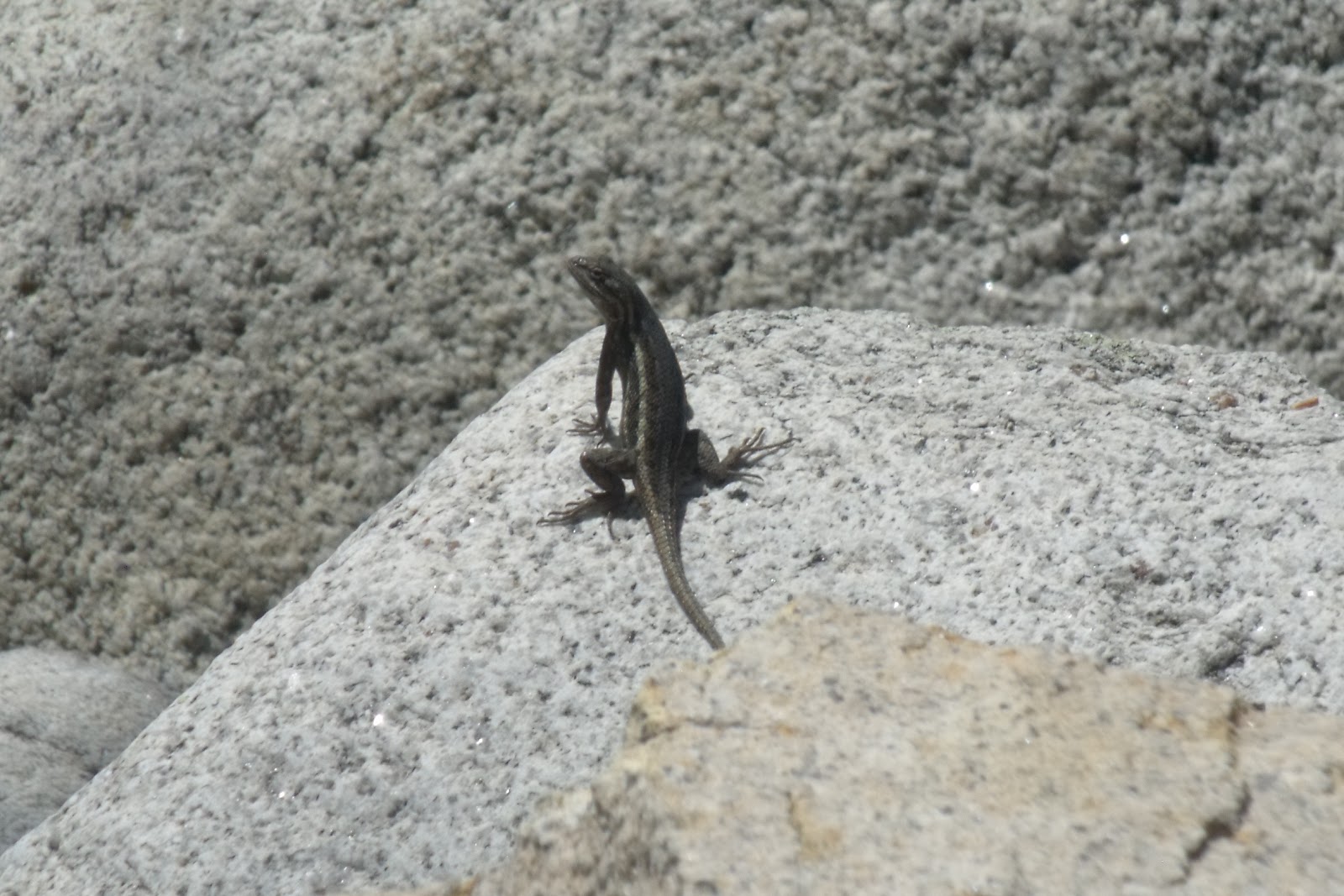
Striped Plateau Lizard
At lunch, birding around the campsite was remarkably good, highlighted by a rare and local Greater Pewee, its more common relative the Western Wood-Pewee, and a Hutton's Vireo, all of which were lifers for me. Unfortunately, we had no more luck on the Buff-breasted Flycatcher front than we had had that morning. Also new was a Nais Metalmark, the only time on this trip that we spotted that flashy orange-and-black butterfly.
Evidence of forest fires near Rose Canyon
That afternoon we headed up the mountain, where aspens began appearing alongside the pines. At an overlook we could see across the wide expanse of desert below to similar "sky island" mountain ranges in the distance. Looking up, we spotted some White-throated Swifts and a Zone-tailed Hawk, and a cool orange, pink and black moth, Virbia ostenta, landed on someone's hand (virtually all moth id credit goes to fellow camper Kyle Kittelburger, whose also has lots of great photos from the trip here: http://www.flickr.com/photos/hawk-eagle/7788912662/in/photostream. Linked photo is of the Virbia moth.)
The view from Aspen Vista
We arrrived at Summerhaven, a tiny "town" at the summit of Mount Lemmon, and stopped at a general store there, where we bought some fudge (raspberry-chocolate fudge is excellent). In the parking lot, we heard and saw fleetingly a Virginia's Warbler, but I didn't see it well enough for me to count it as a life bird. A little ways further, we parked and walked along a trail through excellent riparian habitat. We were hoping for Red-faced Warblers, but couldn't locate any. Additionally, we heard another Northern Pygmy-Owl, but it stayed frustratingly hidden, as did a flock of distant Steller's Jays. As consolation, we saw lots more of the common mountain birds, including plenty of Yellow-eyed Juncos, and some cool non-avians: two cute burrowing Botta's Pocket Gophers, the sole Pacuvius Duskywing of the trip, and dozens, or even hundreds of Echo Azures hanging around a small stream. Also there were some giant water bugs (both an apt description and the actual name of the species) and I saw a cool black-and-white Banded Alder Borer beetle.
Banded Alder Borer
We spent the next night camping at Bear Flats, where we had a couple of closer encounters with Striped Skunks, lots of bats (including one near the bathroom we identified as a Western Small-footed Myotis) and heard a few Great Horned Owls after dinner.

On our last morning in the Santa Catalinas, we made another attempt at the Buff-breasted Flycatcher spot, but were not any more successful, and the bird remained elusive. We did spot an "Aububon's" Yellow-rumped Warbler, the western subspecies of the widespread species, which may be split into a full species soon, and also relocated Grace's and Olive Warblers.

We then packed up our tents and gear, and headed down the mountain, en route to the Chiricahuas, a trip that would take most of the day, with lots of stops. The first was at the Gordan Hirobayashi Campground, which has scrubby habitat with lots of agaves and yuccas. There were a few Rufous-crowned Sparrows, and we saw our first Rock Wren of the trip, a rather drab bird with a very long beak perched on a yucca stalk.

Our next stop was the eastern portion of Saguaro National Park, just outside Tuscon. This was a stop for desert birds, and there were once again plenty of the park's namesake cacti. Typical desert birds that we hadn't seen for a few days were Pyrrhuloxia, Gambel's Quail, Curve-billed Thrasher, Gila Woodpecker, and cactus-nesting Purple Martins. The sought-after Gilded Flicker did not appear, but as we were heading out we had a run of very good luck, and spotted three new birds in just a couple of minutes. The first, and my favorite, was a Greater Roadrunner, the bizzare large ground-cuckoo on which the cartoon is based. Roadrunners are really cool birds, and seeing this one, at very close range, was one of the highlights of the trip. To add to that, we found a Harris's Hawk on a telephone pole and a flock of tiny Black-tailed Gnatcatchers, and left the area with three new birds (plus some cool new butterflies, like Ceraunus Blue, American Snout, and Orange-barred Sulphur).
Harris's Hawk
We eventually made our way out of Tuscon, and ended up on route 10 going east through the Chihuahuan Desert, which, unlike the Sonoran Desert which had just left, is more an arid grassy plain than a cactus-dominated ecosystem. We were pleased to see the characteristic bird of this habitat, the Chihuahuan Raven, which is very difficult to separate from the almost identical Common Raven, but we got a good enough look at the amount of feathering on the bill of one bird to clinch the id. There were also a few Swainson's Hawks, a common western grasslands raptor.
Willcox Sewage Treatment Plant
We stopped for lunch at a Pizza Hut in Willcox, where the abundance of cowboy hats was amusing for the Easterners (myself included) and Californians in our group. The real reason for our being in Willcox, however, was to go to the sewage treatment plant. The Willcox Sewage Treatment Plant is a famed birding location, and has a great reputation as a shorebirding spot. It did not disappoint: in the middle of the desert, this pond is an oasis for migratory shorebirds, and we saw plenty. Long-legged, black-and-white American Avocets and Black-necked Stilts, Baird's Sandpipers, Western Sandpipers, Least Sandpipers, Spotted Sandpipers, Lesser and Greater Yellowlegs, uncommon Stilt Sandpipers, Long-billed Dowitchers, and, most abundant, over 800 Wilson's Phalaropes, feeding in their characteristic method-- spinning in circles to stir up microinvertebrates. It was a very impressive spectacle, and it was also great to be able to study shorebird id with the help of our leader Micheal O'Brian, which quite literally wrote the book (The Shorebird Guide) about shorebird identification. Besides the shorebirds, there were also grassland passerines like the Horned Lark and the "Lillian's" Eastern Meadowlark, the southwestern subspecies that is likely to become a full species in the future.
A big flock of Avocets, Stilts, and Phalaropes
4 species- two avocets on the left, 6 phalaropes, a stilt in the back right, and a dowitcher in the middle
Leaving Willcox, we skirted the northern edge of the Chiricahuas into New Mexico, where we found ourselves driving along a road seemingly in the middle of nowhere, surrounded on all sides by distant mountains with only desert in view. This was also a remarkably good portion of the drive for wildlife, and we spotted a Mule Deer, Black-tailed Jackrabbit, Greater Roadrunners, and we rescued a Western Box Turtle that was dangerously trying to cross the road. By the road we also picked up our first Black-throated Sparrows, a strikingly patterned southwestern specialty, and heard a Cassin's Sparrow.
Western Box Turtle
Box Turtle poses for photos, post-rescue

The desert east of Portal
We soon entered Portal, Arizona, a tiny town whose entire economy is based on being a base for birders exploring the nearby Cave Creek Canyon, arguably the best birding location in the United States. We settled in at our hotel, Cave Creek Ranch (with showers and wifi!), a nice luxury after a few days of camping. It was late in the day at this point, but we still found some birds on the hotel grounds, including a Canyon Towhee. The clear highlight, however, were the awesome, Blue-throated Hummingbirds that were coming to the feeders there. The blue-throats, a specialty of southeast AZ dwarfed all of the more familiar hummingbirds, and chased them away, with their eponymous blue gorgets flashing and tails spread to reveal striking white corners. These were just a taste of the great birds to come over the next four days in the Chiricahuas, our camp's namesake mountains and home to some of the country's (or the world's) coolest birds.
Our rooms at Cave Creek Ranch, underneath the walls of Cave Creek Canyon
Sunset over Cave Creek Canyon