|
| The New Mexican desert east of Portal, AZ |
When I left off this narrative, the thirteen of us at Camp Chiricahua were camping among towering ponderosa pines on Mt. Lemmon. We woke up that morning eager to see as many birds as possible, and there were certainly plenty to be found. The usual suspects from the day before: yellow-eyed juncos, hermit thrushes, pygmy nutchatches, and western bluebirds still dominated, but we found plenty to add to our list. First up, just outside of the campground, was a stunning male
Painted Redstart (as before, life birds, or birds that I had never seen before, are in bold).
This species can only be seen in the U.S. in Arizona and New Mexico, and is strikingly colored in black, white, and scarlet. The species is usually active and energetic, and this one flitted around rapidly and flicked its tail, flashing bright white tail feathers.
 |
| Looking for Buff-breasted Flycatcher |
A little ways down the road, we came across a birding jackpot. A pair of
Violet-green Swallows that flew over were the 600th species on my life list! A tall stand of pines right the picnic area was filled with birds: a burnt-orange-headed Olive Warbler, a lead-colored
Plumbeous Vireo, a female
Western Tanager, a Hepatic Tanager, Mountain Chickadees, and a very nice black, yellow and white
Grace's Warbler. As we returned to the campground we spotted a very cool squirrel, the Abert's Squirrel, which is large and has a strikingly white and fluffy tail. Two of the most aggravating birds of the trip were in this area: Buff-breasted Flycatcher and Northern Pygmy-Owl. The rare flycatcher was giving its characteristic "whit" call repeated at the picnic area, and some people got to see it, but the best I could see was a flash of motion and a speck of a bird, no where near the look I would have liked to have gotten (and not enough for me to count it, at least not yet). The owl started hooting upslope from our campsite when we were eating breakfast. Food forgotten we rushed uphill, but the bird quieted and would couldn't find it, the first of many misses of this species.
 |
| Molino Basin |
After breakfast (we get a lot done pre-food), we headed down the mountain to the Molino Basin, an area dominated by scrubby oaks. The birds here were totally different from those at the higher elevations. Phainopeplas, the sleek, mohawked, red-eyed waxwing relatives, were abundant. In contrast to the pine forests, where Broad-tailed Hummingbirds abound, here the dominant species was the beautiful
Broad-billed Hummingbird, the males adorned in emerald and sapphire hues contrasting sharply with a (broad) red bill. I heard but couldn't see Bewick's Wrens and Bell's Vireo, but we did find a couple
Bridled Titmice (titmouses?), a
Ladder-backed Woodpecker, some Blue Grosbeaks, Hooded Orioles, and a few nice
Rufous-crowned Sparrows, whose songs were more impressive than their rather brown plumage.
 |
| A Female Phainopepla |
The non-birds here were also quite cool, highlighted by an impressive array of butterflies. There were Acacia Skippers, Elada Checkerspots, Desert Cloudywings, Orange-headed Scallopwings, and Two-tailed Swallowtails. The most interesting reptiles were the Sonoran Spotted Whiptails, a lizard species with an interesting reproductive strategy: they parthenogenetic, meaning that are all female, and they are all clones of their mothers.
 |
| Desert Cloudywing |
The next stop was a little higher up the mountain, at the General Hitchcock Campground, which was, like our own campground, pine-dominated. In the parking lot we found a Western Tanager or two, lots of Mexican Jays, and most impressively, at least for me, at least half a dozen clownish Acorn Woodpeckers, which flying to add to or check on their caches of food in dead trees. We walked a short distance towards a dry streambed, on the way spotting a Painted Redstart, our first
Black-throated Gray Warbler, and two interesting squirrels, the Arizona Gray Squirrel and the Arizona Fox Squirrel, the latter a surprising sighting because it is supposed to be restricted to the Chiricahua Mountain Range. The highlight of the stop was in the streambed, where we first heard the excellent song of the
Canyon Wren, which we soon spotted hopping, mouse-like, under some boulders in the stream. It seemed unconcerned by us, and its interesting but rather subdued plumage (brown with a white throat) contrasted strikingly with the exuberance and beauty of its song. You can listen to it here:
http://www.allaboutbirds.org/guide/Canyon_Wren/sounds, but it really has to be heard in its habitat to be truly experienced.
 |
| Canyon Wren, mid-song |
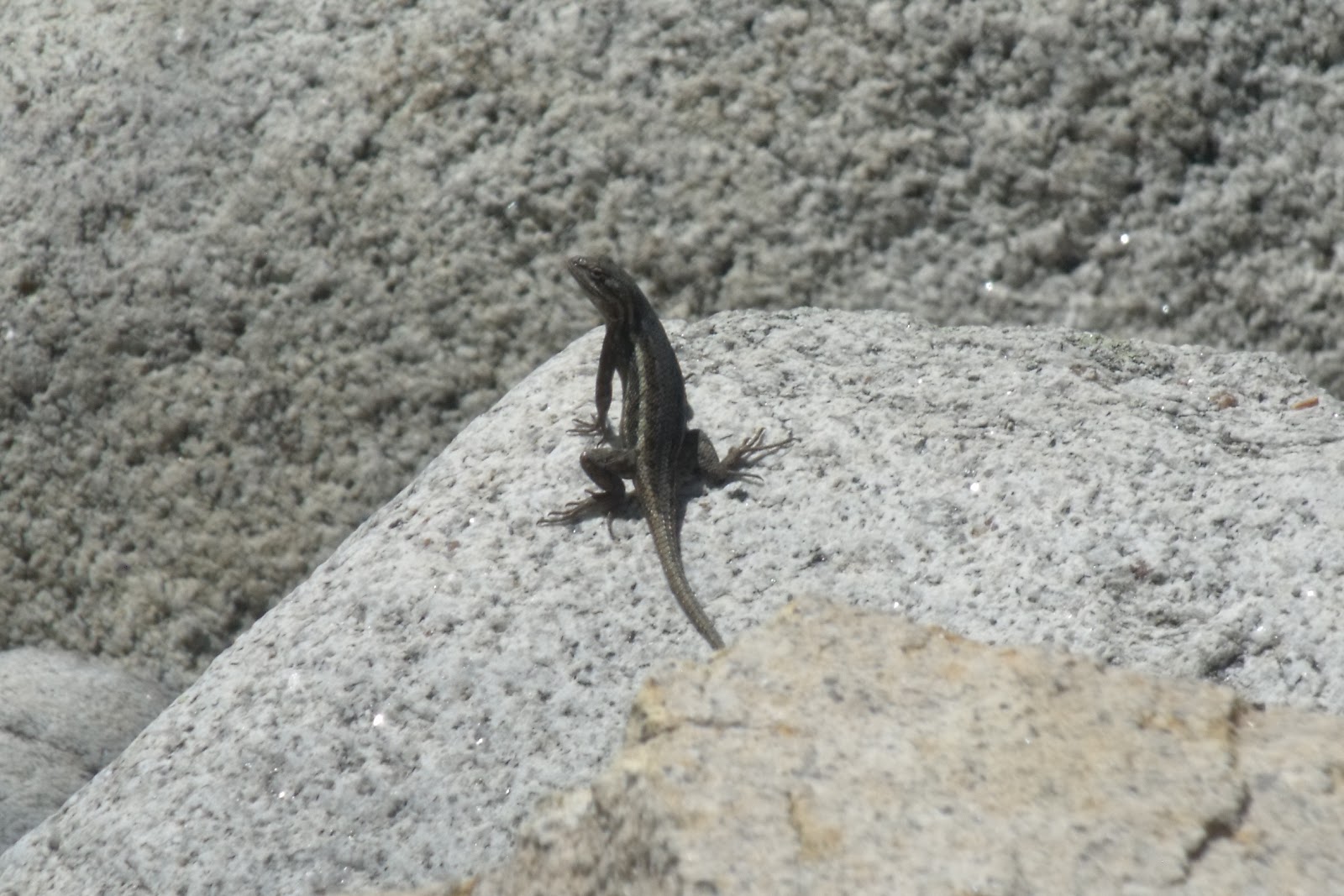
We also got point-blank looks at a Painted Redstart at this spot, plus our first Golden-banded Skipper and Northern Cloudywings (butterflies) of the trip, as well as our only Striped Plateau Lizard. And on the way out we added two more birds: an energetic and fast-moving flock of tiny and long-tailed Bushtits, and a very cool (and unusual) Arizona Woodpecker, a very nice southeast Arizona specialty and one of the few woodpeckers that is brown, not black.
 |
| Golden-banded Skipper |
 |
| Striped Plateau Lizard |
At lunch, birding around the campsite was remarkably good, highlighted by a rare and local
Greater Pewee, its more common relative the
Western Wood-Pewee, and a
Hutton's Vireo, all of which were lifers for me. Unfortunately, we had no more luck on the Buff-breasted Flycatcher front than we had had that morning. Also new was a Nais Metalmark, the only time on this trip that we spotted that flashy orange-and-black butterfly.
 |
| Evidence of forest fires near Rose Canyon |
That afternoon we headed up the mountain, where aspens began appearing alongside the pines. At an overlook we could see across the wide expanse of desert below to similar "sky island" mountain ranges in the distance. Looking up, we spotted some
White-throated Swifts and a Zone-tailed Hawk, and a cool orange, pink and black moth,
Virbia ostenta, landed on someone's hand (virtually all moth id credit goes to fellow camper Kyle Kittelburger, whose also has lots of great photos from the trip here:
http://www.flickr.com/photos/hawk-eagle/7788912662/in/photostream. Linked photo is of the
Virbia moth.)
 |
| The view from Aspen Vista |
We arrrived at Summerhaven, a tiny "town" at the summit of Mount Lemmon, and stopped at a general store there, where we bought some fudge (raspberry-chocolate fudge is excellent). In the parking lot, we heard and saw fleetingly a Virginia's Warbler, but I didn't see it well enough for me to count it as a life bird. A little ways further, we parked and walked along a trail through excellent riparian habitat. We were hoping for Red-faced Warblers, but couldn't locate any. Additionally, we heard another Northern Pygmy-Owl, but it stayed frustratingly hidden, as did a flock of distant Steller's Jays. As consolation, we saw lots more of the common mountain birds, including plenty of Yellow-eyed Juncos, and some cool non-avians: two cute burrowing Botta's Pocket Gophers, the sole Pacuvius Duskywing of the trip, and dozens, or even hundreds of Echo Azures hanging around a small stream. Also there were some giant water bugs (both an apt description and the actual name of the species) and I saw a cool black-and-white Banded Alder Borer beetle.
 |
| Banded Alder Borer |
We spent the next night camping at Bear Flats, where we had a couple of closer encounters with Striped Skunks, lots of bats (including one near the bathroom we identified as a Western Small-footed Myotis) and heard a few Great Horned Owls after dinner.
On our last morning in the Santa Catalinas, we made another attempt at the Buff-breasted Flycatcher spot, but were not any more successful, and the bird remained elusive. We did spot an "Aububon's" Yellow-rumped Warbler, the western subspecies of the widespread species, which may be split into a full species soon, and also relocated Grace's and Olive Warblers.
We then packed up our tents and gear, and headed down the mountain, en route to the Chiricahuas, a trip that would take most of the day, with lots of stops. The first was at the Gordan Hirobayashi Campground, which has scrubby habitat with lots of agaves and yuccas. There were a few Rufous-crowned Sparrows, and we saw our first Rock Wren of the trip, a rather drab bird with a very long beak perched on a yucca stalk.
Our next stop was the eastern portion of Saguaro National Park, just outside Tuscon. This was a stop for desert birds, and there were once again plenty of the park's namesake cacti. Typical desert birds that we hadn't seen for a few days were Pyrrhuloxia, Gambel's Quail, Curve-billed Thrasher, Gila Woodpecker, and cactus-nesting Purple Martins. The sought-after Gilded Flicker did not appear, but as we were heading out we had a run of very good luck, and spotted three new birds in just a couple of minutes. The first, and my favorite, was a
Greater Roadrunner, the bizzare large ground-cuckoo on which the cartoon is based. Roadrunners are really cool birds, and seeing this one, at very close range, was one of the highlights of the trip. To add to that, we found a
Harris's Hawk on a telephone pole and a flock of tiny
Black-tailed Gnatcatchers, and left the area with three new birds (plus some cool new butterflies, like Ceraunus Blue, American Snout, and Orange-barred Sulphur).
 |
| Harris's Hawk |
We eventually made our way out of Tuscon, and ended up on route 10 going east through the Chihuahuan Desert, which, unlike the Sonoran Desert which had just left, is more an arid grassy plain than a cactus-dominated ecosystem. We were pleased to see the characteristic bird of this habitat, the
Chihuahuan Raven, which is very difficult to separate from the almost identical Common Raven, but we got a good enough look at the amount of feathering on the bill of one bird to clinch the id. There were also a few Swainson's Hawks, a common western grasslands raptor.
 |
| Willcox Sewage Treatment Plant |
We stopped for lunch at a Pizza Hut in Willcox, where the abundance of cowboy hats was amusing for the Easterners (myself included) and Californians in our group. The real reason for our being in Willcox, however, was to go to the sewage treatment plant. The Willcox Sewage Treatment Plant is a famed birding location, and has a great reputation as a shorebirding spot. It did not disappoint: in the middle of the desert, this pond is an oasis for migratory shorebirds, and we saw plenty. Long-legged, black-and-white American Avocets and Black-necked Stilts, Baird's Sandpipers, Western Sandpipers, Least Sandpipers, Spotted Sandpipers, Lesser and Greater Yellowlegs, uncommon Stilt Sandpipers,
Long-billed Dowitchers, and, most abundant, over 800
Wilson's Phalaropes, feeding in their characteristic method-- spinning in circles to stir up microinvertebrates. It was a very impressive spectacle, and it was also great to be able to study shorebird id with the help of our leader Micheal O'Brian, which quite literally wrote the book (
The Shorebird Guide) about shorebird identification. Besides the shorebirds, there were also grassland passerines like the Horned Lark and the "Lillian's" Eastern Meadowlark, the southwestern subspecies that is likely to become a full species in the future.
 |
| A big flock of Avocets, Stilts, and Phalaropes |
 |
| 4 species- two avocets on the left, 6 phalaropes, a stilt in the back right, and a dowitcher in the middle |
Leaving Willcox, we skirted the northern edge of the Chiricahuas into New Mexico, where we found ourselves driving along a road seemingly in the middle of nowhere, surrounded on all sides by distant mountains with only desert in view. This was also a remarkably good portion of the drive for wildlife, and we spotted a Mule Deer, Black-tailed Jackrabbit, Greater Roadrunners, and we rescued a Western Box Turtle that was dangerously trying to cross the road. By the road we also picked up our first
Black-throated Sparrows, a strikingly patterned southwestern specialty, and heard a Cassin's Sparrow.
 |
| Western Box Turtle |
 |
| Box Turtle poses for photos, post-rescue |
 |
| The desert east of Portal |
We soon entered Portal, Arizona, a tiny town whose entire economy is based on being a base for birders exploring the nearby Cave Creek Canyon, arguably the best birding location in the United States. We settled in at our hotel, Cave Creek Ranch (with showers and wifi!), a nice luxury after a few days of camping. It was late in the day at this point, but we still found some birds on the hotel grounds, including a
Canyon Towhee. The clear highlight, however, were the awesome,
Blue-throated Hummingbirds that were coming to the feeders there. The blue-throats, a specialty of southeast AZ dwarfed all of the more familiar hummingbirds, and chased them away, with their eponymous blue gorgets flashing and tails spread to reveal striking white corners. These were just a taste of the great birds to come over the next four days in the Chiricahuas, our camp's namesake mountains and home to some of the country's (or the world's) coolest birds.
 |
| Our rooms at Cave Creek Ranch, underneath the walls of Cave Creek Canyon |
 |
| Sunset over Cave Creek Canyon |