...is still a good day if you can see gannets, my favorite bird, while lying down in bed.
And tomorrow could be even better, since I'm headed to Manomet Point for some more stormbirding.
Showing posts with label Summer. Show all posts
Showing posts with label Summer. Show all posts
Monday, August 23, 2010

Sunday, November 1, 2009
Shorebirding at Jamaica Bay

Unfortunately, actually getting that one trip was tricky. I opted out of a NYS young birders' club trip there in favor of a weekend at the beach. A missed text message would have given me another opportunity. August ended without a JBWR trip. Still, I wanted to go. So finally, on September 13 (2 months ago by now), I got there. I'm glad I did.
The first stop was halfway up the east pond. There, I saw Parulas, yellowlegs, shovelers, and teal. On the way back, I found a northern waterthrush, peregrine falcon, and palm warblers.
A drive and then walk, which was somewhat lengthened by a wrong turn, brought me to the northern shore of the east pond. There, I saw why everyone I talked to said to bring boots. I was glad I had listened to them. The mud there is deep, sticky, and muddy.
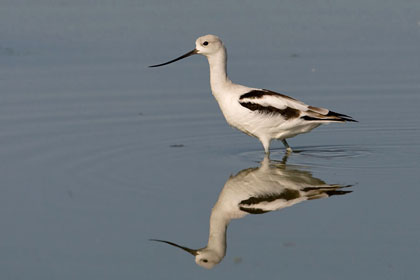
One of my target birds was the pair of american avocets, which are unusual on the east coast but had been seen there recently. They were a few steps down from the start of the trail in the middle of the "pond"(really a area of wet mud), in a group of canada geese. Awesome. Lifer #1.
I continued down along the pond, spotting lesser yellowlegs and least sandpipers, and navigating the trecherous cove, the muddiest part of the trail. Soon after that, I found a pair of birds that I realized were stilt sandpipers, another target and lifer #2. A single little blue heron was also present, along with some forster's terns.
I reached another birder with a scope, and he helpfully pointed out my life pectoral sandpiper. A red knot in the same flock of birds was also a lifer. I missed the long-billed dowitcher that was in the same flock when a merlin spooked all the birds. After a couple more minutes, I had to leave. It had been just 30 minutes that I was on the east pond, and I saw 4 life birds. This really shows how great Jamaica Bay is for shorebirds.
And maybe next year i'll go in August.
Eamon Corbett
Monday, October 26, 2009
Race Point Pelagics

A non-birding trip from my beach house to provincetown, on the tip of cape cod, brought me to race point beach. I had been reading the reports of hundreds of shearwaters being seen there, and there had even been a sabine's gull the previous day. My expectations were not for hundreds of anything or any rarities, but I thought that I might see a couple birds.
From the visitor's center, I could scope a greater shearwater and lots of terns. Some were probably roseate, but I still can't tell them apart, especially from over a mile away. Still, the shearwater was my first from land. A whale was spotted, right next to a whale watch boat, but I didn't see it.
I hurried down to the beach, and set up my scope.
By the way, my scope is not great. It is a $60 scope on a $15 dollar tripod. It has gotten me some cool birds I wouldn't have seen otherwise (Barnacle Goose, Harlequin Duck, etc), but in terms of magnification and quality, it isn't great.
As a result, I didn't get great looks at any of a couple shearwaters that flew by. But I had had my great shearwater looks in July (see earlier post), so it was no problem.
My dad spotted a bird flying fast toward us. Really fast, with really strong wingbeats. Gull size, chasing a tern. Any guesses?
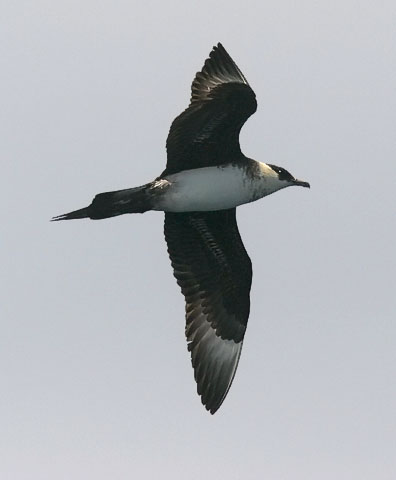
Yep, it was a jaeger. And luckily, it was a light adult, so id was not impossible. Too dark for long tailed, to small for pomeraine. Long, pointed central tail feathers. Parasitic Jaeger. Lifer.
In an amazing display of acrobatics, it and the tern dove, spun, twisted, and did pretty much everything to get away or keep up. I'm not sure who won, but I think it was the jaeger. It flew off and landed on the water, next to another bird. The second bird- my second ever jaeger. I can only assume it was parasitic. I didn't get a good enough look to be sure.
Really awesome birds.
A close up seal was the next prize, and we headed home.
Corbett
Oh, and I realized why there hadn't been hundreds of shearwaters, etc. That report had been from 5:30 in the morning. I prefer my method.
Monday, October 12, 2009
Supurb Summer for Birding- Part 2- Wild Dove Chase
 (from www.birdfinders.co.uk)
Another Friday, another Friday Morning Birders trip. This time, we set off to chase down a rarity- a White-winged Dove being seen in Manomet, Plymouth. It was the 7th record in Massachusetts.
The drive was probably 30-40 minutes, and when we arrived there were two birders already leaving, having seen the bird earlier. Ian Davis, the birder who had found the dove at his feeders, was outside. He reported that it had been seen recently, but flew across the adjacent pond and hadn't been seen since. We waited in the road and scanned the other side of the pond, hoping that it would fly back. It didn't. Our leaders, David and John, exchanged cell phone numbers with Ian, and we left for Manomet Point, hoping that the phone would ring to inform us of the dove's whereabouts.
The point was decent, but not great. We found turnstones, red-breasted mergansers, some eiders, and some not-bonaparte's gulls (we tried to make a few laughing gulls into bonaparte's, but they weren't.) On the way there and back, we drove slowly through the neighborhood across from Ian's house where the dove had flown to. On the way back, we searched extensively.
Below- The View From Manomet Point

Our group was in three vans. We could communicate with radios that we had in each. At one point, the first car, with David driving, stopped. After a minute, we began wondering what they were looking at. But we were sure that if the WWDO was actually in view, they would radio us. Then a bird flew off the wire and into a wooded area behind someones house. It had white wing patches.
The first van pulled up, and David jumped out. "Do you see it?" "That was it!" "Why didn't you back up?" "Is your radio on?" "We were trying to radio you to tell you to back up so the car doors opening wouldn't scare it." Turns out our radios were fine. His was broken. We had gotten a look at it, but not a very good one.
For some reason, the owner of the house that we were parked in front of was watching this whole thing. It was also his yard that the bird had flown into. David hurried over, and explained the situation. The guy probably thought we were crazy (we probably were), but he let the 15 or so complete strangers into his yard to see the bird. Thank you to that guy.
So we were staring into a tangle of vines and dense brush and trees. A redstart was distracting, but only for a millisecond. Then we got back to work. I was the first to spot it, a distinctive dove with a bright blue eye-ring and white on the side of its wing. We all admired it for 15 or 20 minutes, through a scope and with binoculars. The trees were so close together that there were only 2 spots were you could get a good look at it, but good look we got. Great bird. After stopping by to tell Ian of our success, we headed back, but not before stopping to get solitary sandpiper and rock pigeon, the 3rd dove of the day, at Damon's Point on the north river.

Above- The thicket where the Dove was found.
The dove was a great bird, and the story is good too. It was the first time the Friday Morning Birders saw the bird it the 21 year history of the group/walk/trip. It even had to be written onto the Field Card we used for our checklist. Somewhat ironically, this was the one FMB trip where I did not see a life bird. I had seen the dove before in florida. But this was a much better, longer, and more definite view, and it was in MA, so it was rare. Definitely one of the better FMB trips.
Eamon Corbett
Supurb Summer for Birding- Part 1- 3 at 3rd Cliff

From http://www.capebretonbirds.ca
First off: I am way way behind on these posts, so I am going to have a few from the summer, and then one from recently, and then I will be caught up.
On July 31 I joined Mass Audubon's weekly Friday Morning Birders bird walk, where we take a van to various birding spots on the south shore (massaudubonblogs.typepad.com/southshorejournal). I have gone 7 times by now, and gotten a life bird on 6 of them. This time, we went to Scituate, just north of where the trip meets, in Marshfield. Our first stop was 3rd cliff, a beach that is at the mouth of two rivers, right where they join the ocean. The ocean side was reletively empty, but the river mouth had shorebirds. There were a few points of land that had just been exposed to the tide. The first was sand, and we picked out turnstones, semipalmated and black-bellied plovers, terns, gulls, and many sanderlings and semipalmated sandpipers. One bird looked different- smaller than the gulls and larger than the sandpipers. Its bill was hidden, but after we got closer it began preening, and the long, decurved bill of a Whimbrel was obvious. Life bird!
The next spit was covered in small rocks. It turns out only some of them were actually rocks. There were hundreds of Semipalmated Sandpipers covering the whole area. It was amazing, because you could hardly tell there were any until you looked closely. By this time, we were nearing the Piping Plover and Least Tern nesting sites on the beach, and we spotted adults and chicks of both species. Taking another look at the shorebirds, one of the leaders found a black tern, my second lifer of the day. 15 minutes later, when we tried to relocate it, we discovered that there were actually 2 black terns.
Some other good birds included a Savannah Sparrow, Horned Lark, and a flock of 6 whimbrels that I spotted.
The next spot was a muddy parking lot at a public beach. In the puddle, there were semi plovers, semi sandpipers, and my first White-rumped Sandpipers!
The last stop was a lighthouse, where we scanned the sea to find a handful of moving black specks- Wilson's Storm-petrels.
All in all, a very good morning of birding, with 3 lifers, a few more cool birds, and 13 shorebirds (20 if you count gulls and terns)
Eamon Corbett
Friday, August 28, 2009
Surprise Skimmers at Plymouth Beach


With the number of terns I had seen from the whale watch and the posibility of arctic or roseate terns, I could not resist a visit to Plymouth Beach. There is a huge tern colony at the tip of Plymouth Beach, with hundred or thousands of common terns, plus a handful of roseates. The latter 2 were my targets.
Plymouth Beach is also known as Plymouth Long Beach, and with good reason. The walk to the tern colony was almost three miles, some of it in soft sand. On the way I found mixed shorebirds, including dowitchers and willets, and some endangered Piping Plovers.
 (A juvenile Piping Plover, Plymouth Beach, MA)
I left my dad and sister after around 1.5-2 miles, when they turned back. I continued on to the tern colony. Least terns and shorebirds became more abundant, and then came the dunes. At the tip of the spit of land that the beach is on is a area of dunes, and that is where the terns nest. I scanned the flocks from a distance. There were many flying in every direction over the dunes, and a few hundred facing the same direction on the sand. I found a few individuals that could have maybe been arctic terns, but I am not good enough to know for sure. (Below- Arctic Tern? Who Knows?)

The birds on the beach were not near their nests, so I tried to get closer, but a handful of birds flew up and dive bombed me, screaming and flying at my head. Instead of trying to get any closer, I moved around the flock, trying to find unusual terns and marveling at the numbers and the noise. Tern are pretty loud birds. And 1,000 terns are really loud. They make a variety of calls, screeches, screams, and more.
Around this time I heard a different sound, and turned around to see a black skimmer flying up the beach behind me. It called a few more times, and then flew into a portion of the dunes close to and visable from the beach. I had seen them before in Florida and Cape May, but this bird was a huge surprise. I didn't even think that there range extended that far north. I study the skimmer for a few minutes, and then moved a little farther down the beach. When I returned, there were 2 skimmers sitting in the dunes.
When I got home, I did a little research on skimmers in MA, and found that they were unusual and erratic, and that nesting birds were very rare. I also learned that these particular skimmers had been seen before were known to be nesting, the only pair in MA and the northernmost nesting pair in the country. Over the next few weeks, I heard a couple of people talking about going to plymouth beach to see the skimmers.
I had gone to the beach for the terns, and stumbled upon the skimmers.
Eamon Corbett
Tuesday, July 21, 2009
Stellwagen Bank Pelagics


 Greater Shearwater (Top and Middle) and Humpback Whale- My camera died before I could get any other photos.
On July 13, 2 and a half weeks ago, I went on a Captain john Boats whale watch out of plymouth harbor in MA. After leaving the harbor and passing the Mayflower II, Plymouth Rock (overrated), and the tern colonies on Plymouth Beach, we got into Cape Cod Bay. I was looking for pelagics and whales.
Wilson's Storm Petrels showed early, just as we were out of the harbor. There were a couple flitting around behind another boat. We would see many of them by the end of the day. Storm-Petrels were secondary here. My main target were the 4 reported shearwaters and the 3 jaegers.
My first glimpse of a large shearwater was inconclusive, with my binoculars being unsteady when the boat rocked and the bird far away. No matter. Soon I had located a sooty shearwater out in front of the boat, flying left to right. Lifer number 1. Then I saw a greater shearwater flying by the boat. And then another. Lifer 2 There was never any shortage of them, with one in sight almost the whole trip after this. The boat passed right by some large rafts, giving close looks. In one of the larger rafts, I picked out a Cory's Shearwater (lifer 3), and the naturalist took a break from the whales to pick out another. My camera battery died at this point, leaving me with the above photos only.
Oh, I forgot to mention the whales. This was, after all, a whale watch. We saw multiple pairs of humpbacks, including interesting behavior- breaching (jumping), and fin-slapping, as well as a mother-calf pair right next to the boat.
The grand finale came after the naturalist got a call from other whale watching boats, reporting many whales at a location to the east of us. We headed over, and found ourselves facing a huge underwater school of bait fish. Above it was a flock of shearwaters, gannets, and gulls numbering over 1000 birds, mostly greater shearwaters. Inside it many whales, including fin, minke, and humpback. We could see pairs of whales in every direction, with probably 10+ in total. The numbers of shearwaters were incredible. If you closed your eyes, the loudest thing yoo could hear was the pattering slapping sound of their feet against the water as they took off in front of the boat. It was specatcular.
Unfortunately, we were already behind schedule, and had to leave after only 10-15 minutes. Given more time, I might have been able to pick out a manx shearwater or jaeger. Still, it was great, and on the return trip I saw dowitchers and hundreds of terns on plymouth beach.
Great trip. If you ever have a chance to go on a pelagic or whale watch, do it.
Part 3- Hammo
The day after doodletown, went with Benjamin and Ryan to Hammonassest SP in connecticut in the evening, mainly for marsh sparrows, but also for some other stuff that had been reported there. We missed cattle egret in one parking lot, after only a half-hour or so, we had seen glossy ibis, willet, martin, little blue heron, and killdeer.
A walk to the end of the moraine trail produced common and least terns, as well as the king eider we were looking for, with 2 surf scoters. The eider was a lifer and ABA bird 250 for me.
On the way back we saw saltmarsh sharp-tailed sparrows, and some of them actually stayed in view for a couple seconds. Easily my favorite sparrows.
A walk onto the ceder island trail as the sun was setting yielded seaside and sharp-tailed sparrows, with the seaside sparrows being a lifer. Fighting mosquitos and gnats on the way back to the car, we found a willow flycatcher and more ibis to end the day.
Corbett
Part 2- #250 at Doodletown
I am way behind on these blog posts, so this will be short. Actually, for this post and the next one, you could just go to Benjamin Van Doran's blog- warblings.wordpress.com. That would save me some time, and he was on both of the trips. Anyway- I went to Doodletown, NY with the NYS Young Birders club a long time ago (about 3 weeks- the day after the rails at marshlands) I had 248 birds on my life list when I got there, and was hoping for my 250th. Warbling Vireo, black vulture, and indigo bunting were in the parking lot, but after that it was quiet until we stumbled across a small group of warblers. Hooded sang and then appeared right next to the trail. 249. Worm-eating warbler called and then was spotted in a more distant tree. 250!! Cerulean was found preening in a very distant tree. 251. Yay. Things were quiet visually (doesn't make any sense, but you get the idea) for a while, despite more vocal ceruleans. A louisiana waterthrush (in a tree!) was another lifer. A very close worm-eating warbler supplemented the distant sighting earlier. And a yellow-throated warbler far above us was the last lifer of the trip.
I have never been to Doodletown in mid-may, when birding is best, but even in late june I saw 5 lifers, with worm-eating warbler being my 250th.
Good Birding,
Eamon Corbett
Monday, June 29, 2009
A Sufficiently Awesome Weekend- Part 1- Marsh Hen Tide
 (From 10000 birds- a great birding site/blog)
I have gone birding 3 times in the past three days, and was going to post them all in one post, by now am breaking it up into 3 parts.
Part I- Marsh Hen Tide
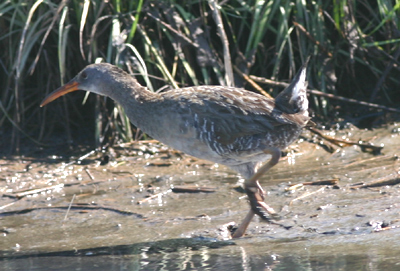
On Friday I headed over to the marshlands conservancy. It had rained so much over the past few days, plus it was a new moon 3 days before, so the tide was very high. That was exactly why I was there. I had sort of seen clapper rail before. (See my post, Ruffing It) But that had been a calling bird, and then I had seen a moving shape that could have been anything. It was not the kind of look I wanted for a lifer, but I counted it anyway. I don't know why, and I probably shouldn't have. This time I wanted a good look. So I went at a very high tide, hoping for the phenomenon known as a "marsh hen tide," when the highest tides of the year would drive the rails out of the center of the marsh and make them visable for once.
It worked. After checking out some other spots and getting indigo bunting, yellowthroat, willet, common tern, and marsh wren, I headed to the rail spot. I sat on a bench overlooking the marsh, and began scanning. Egret, Mallard, Egret. Then, by a clump of higher reeds, a head popped up, with a long bill and red eye. I had my rail. I then slunk across the marsh, but because the tide was so high, it was visable the whole time. Then it got to a spot with more water, and swam out of sight. Very, very cool bird. Looking back to where the first rail had been spotted, I saw another one poke its head up, then disappear. No marsh sparrows, but after seeing the rails, I can't complain. Plus, there will be another time for marsh sparrows (foreshadowing alert!- see later posts in this series)
Good Birding,
Corbett
Subscribe to:
Posts (Atom)