Wednesday, June 30, 2010
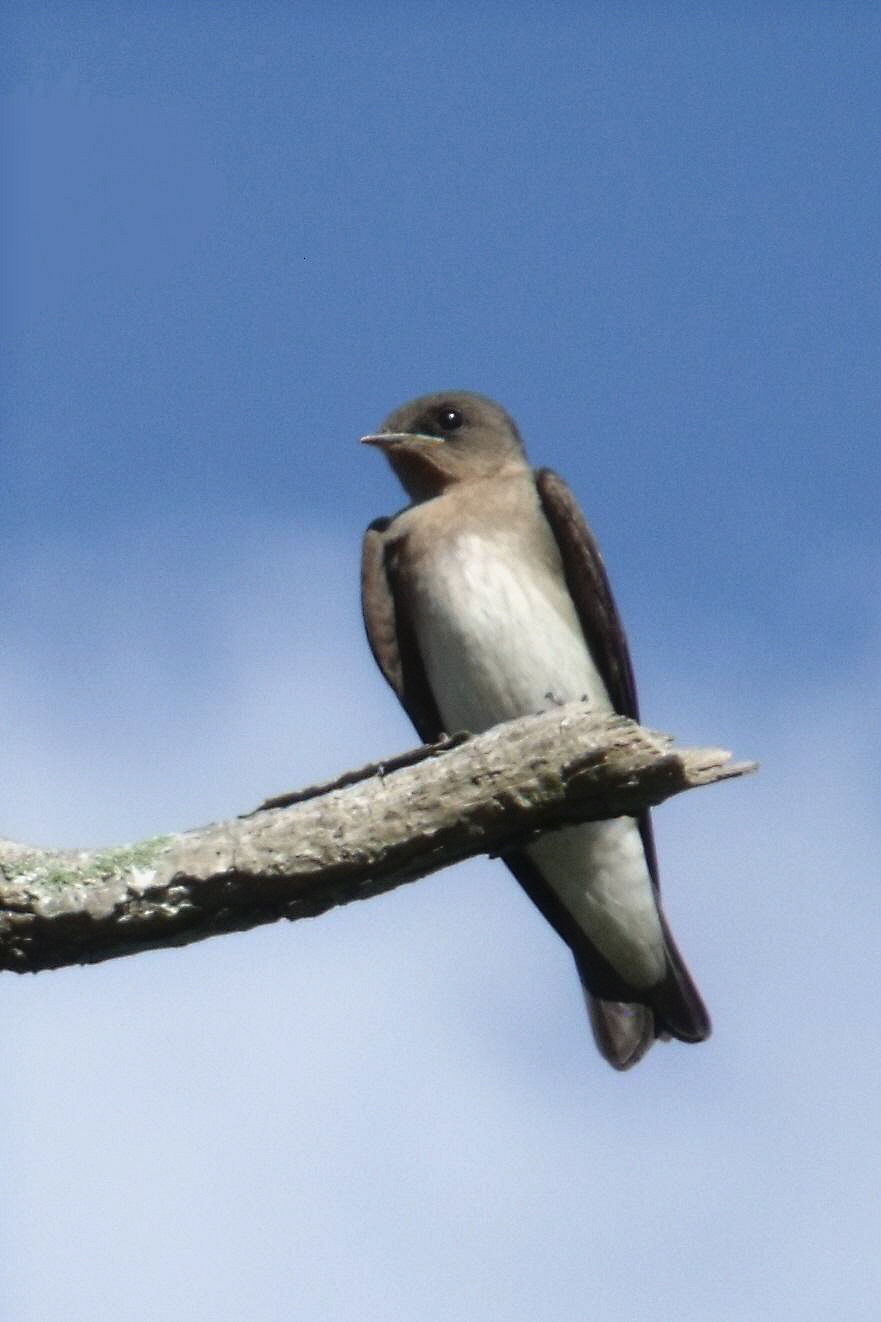
Young Northern Rough-Winged Swallows
There were quite a few of these juvenile swallows perched on snags over the marsh at the marshlands conservancy last week:
Monday, June 14, 2010
Memorial Day Sedge Wren
Sorry I haven't posted in a while- I've had finals, and been away for the past 3 weekends. The first of those three, Memorial Day, I went to my beach house in Massachusetts. I was lucky, and there had been a Sedge Wren, rare in MA and difficult to see anywhere, at the local wildlife sanctuary, Daniel Webster Audubon.
So as soon as we arrived, I went to the sanctuary to see if I could find it. There were Bobolinks and Purple Martins everywhere- Daniel Webster is primarily a grassland (good for bobolinks) and there is a large martin colony there. A Willow Flycatcher, Great Egret, and Osprey were also notable.
I made my way to the Fox Hill observation platform, where the wren had been seen. There were two people there. Thee wren had not been seen or heard in 30 minutes, they said. After 15 minutes of waiting and listening, the wren sang, then flew directly towards us, landing in a clump of grass, then perching near the top to sing- great looks. It dove back into the grass, and emerged a ways to the right, and slightly closer. It moved around a bit more, then flew even closer, giving great looks from 10-15 feet away, before sinking into the brush again, and falling silent. Great looks at a life bird, and one the is apparently not prone to giving great looks, ever.
No shots of the Sedge Wren, but some miscellaneous photos from the short trip:
Flicker-
Bobolink-
Bobolink Paradise (I know there is one in this photo, but I can't find it. Can you?)-
And finally, a difficult (I think) if not impossible quiz. I think the bloggers at 10000birds have the "diabolical quiz" thing trademarked, but this is one. Post your guess as a comment-
Good Birding!
Monday, May 17, 2010
State Birds--Revised
State birds have annoyed me for pretty much as long as I have been birding. None of them seem to make any sense, and very few show any real knowledge about the state's birdlife. The lack of creativity is incredible- 7 states have the cardinal as their state bird, 5 have the mockingbird.
So I decided to change the birds around a bit, with a few rules-
Comments are encouraged! There is absolutely no way that you would agree with me on all 51 of these, so voice your opinion about what could be changed.
Alabama -- It was the Yellowhammer, or Northern Flicker, but that doesn't satisfy rule #3, and Swallow-tailed Kite is cooler anyway.
Alaska -- The Willow Ptarmigan is actually a pretty good choice. While there might be a couple better birds, (Ivory Gull, Puffins or Alcids, Gyrfalcon), Alaska can stick with the ptarmigan.
Arizona -- Cactus Wren, the current state bird, isn't bad, but it is brown, and fairly drab. Neither of those characteristics can be associated with the Elegant Trogon, on the other hand, the most brightly colored of the Chiricahua Mountain specialties.

from Wikipedia
Arkansas -- The "Lord God Bird" itself- Ivory-billed Woodpecker. Who cares if it is maybe/probably extinct- it's still a better state bird than the mockingbird.
California -- There are tons of birds in this state, but the California Condor is the largest and the rarest. The current state bird is the California Quail.
Colorado -- (Currently Lark Bunting) Colorado is that state that is most associated with the Rocky Mountains, so I went back and forth between two mountain birds- the American Dipper and Clark's Nutcracker, and decided on the dipper.
Connecticut -- Hermit Thrush has a better song than the American Robin, and Vermont (which currently has the Hermit Thrush) can just take some boreal finch or Bicknell's Thrush.
Delaware -- Seriously, Blue Hen Chicken? Chickens do not make good state birds- they are neither majestic or native. The Red Knot, on the other hand, is native and threatened, and huge numbers stop in Deleware bay during migration
District of Columbia -- (Not technically a state, but they do have an official bird) I was thinking this would be the eagle, but it turns out that it is actually the Wood Thrush, which I'm fine with.
Florida -- Florida has some of the best birds in the country, so having a Mockingbird as the state bird is stupid. There are a few contenders here- Snail Kite, Florida Scrub Jay, Roseate Spoonbill, and Purple Gallinule. Tough choice, but I'll go with the gallinule.
Georgia -- Brown Thrasher is Ok, I guess, though it is pretty close to a mockingbird...
Hawaii -- Nene is cool, but it's still a brown goose. It is endangered, but so is basically every bird in Hawaii. Honeycreepers are more colorful, and the whole family is restricted to Hawaii, so one of those should be the state bird. My pick is the I'iwi.
(From http://www.stanford.edu/~petelat1/iiwi4.jpg)
Idaho -- Mountain Bluebird. It's blue.
Illinois -- I just picked a warbler for Illinois, to replace the cardinal, because there were no other birds that I could think of. Magnolia Warblers are cool.
Indiana -- Now I sort of see why there are so many Cardinals as state birds. I couldn't think of anything else, so I'm sticking with the Northern Cardinal.
Iowa -- I have no idea, so stick with American Goldfinch.
Kansas -- Western Meadowlark is the state bird of a lot of western states (but interestingly, the Eastern Meadowlark is not a state bird of anything), but here it actually fits.
Kentucky -- It's May, so I'm overloading the Eastern U.S. with warblers, but I'm not going to say Kentucky Warbler. Red-headed Woodpecker works.
Louisiana -- Brown Pelican- that is, if there are any left in the state after that oil spill.
Maine -- (Was Black-capped Chickadee) Definitely Atlantic Puffin. No doubt about it.

Wikipedia
Maryland -- They did name their baseball team after it, so Baltimore Oriole has to stay as the state bird.
Massachusetts -- (Was also Black-capped Chickadee) Something like half of the world's population of Piping Plovers breed in MA.
Michigan -- This is the easiest one on the whole list- Kirtland's Warbler.
Minnesota -- Common Loon is on their state quarter and everything, so I guess they wouldn't be happy if it was changed it to Boreal or Great-Gray Owl.
Mississippi -- Mockingbird is fine, but Great Blue Heron is better.
Missouri -- NY gets to keep the Bluebird, so Missouri has to switch. Eurasian Tree Sparrow isn't native, but Ruby-throated Hummingbird is, and there aren't any other hummers on this list.

Wikipedia
Montana -- Greater Sage Grouse deserves to be listed here, and on the endangered species list, but not on the menu of a french bistro. (If you have no idea what I'm talking about, go here.)
Nebraska -- Sandhill Crane- in migration flocks can number in the hundreds of thousands.
Nevada -- Umm...Hmm...Uh... Give me a minute. (flips through Sibley's) I've got it! Golden Eagle.
New Hampshire -- Purple Finch is OK, but Gray Jays have more charisma.
New Jersey -- (Was American Goldfinch) Cape May is one of the best birding spots in North American, and there is no single species that represents the birdlife of Cape May or New Jersey, but the Cape May Warbler is named after it, so...
New Mexico -- Greater Roadrunner is good.
New York -- It's Eastern Bluebird, and it's going to stay that way.
North Carolina -- (Was Cardinal) Cerulean Warbler is awesome.
North Dakota -- Gyrfalcon!!
Ohio -- Fine. The "Warbler Capital of the World" can have Blackburnian Warbler. See if I care.

http://www.learner.org/jnorth/images/graphics/u-z/Warbler_Blackburnian_MikeMcDowell.jpg
Oklahoma -- Scissor-tailed Flycatcher is good.
Oregon -- Varied Thrush. (Was Western Meadowlark, but so were a lot of other states)
Pennsylvania -- Ruffed Grouse- Why not?
Rhode Island -- Rhode Island Red Chicken- here we go with domestic birds as state birds again. How about Peregrine Falcon. Why? Because I saw my first one here. Not that anyone else would care, but seriously, who's going to complain about having a falcon instead of a chicken?
South Carolina -- Carolina Wren makes sense, but Painted Bunting is more brightly colored. By a lot.
South Dakota -- Ring-necked Pheasant is not native, so I'd go with Snowy Owl, even though I don't know how common or uncommon they are there.
Tennessee -- Tennessee Warbler! No, Nashville Warbler... See what I mean about the warbler overload? Whip-poor-Will is unique, though it could be difficult to explain why your state bird is called a goatsucker...
Texas -- Another great birding state with a mockingbird. I was debating between Green Jay and Roseate Spoonbill, but the spoonbill is pink, so it wins.

www.tringa.org/
Utah -- There is actually a good story behind this one. California Gulls saved Mormon settlers by eating a swarm of crickets that would have otherwise destroyed their crops. There is a monument in Salt Lake City commemorating this, known to the Mormans as the "Miracle of the Gulls."
Vermont -- Hermit Thrush has been taken by Connecticut, but Vermont has boreal birds, so there is no problem replacing it. White-Winged Crossbill would be good.
Virginia -- Another Cardinal state. I know there have been a lot of warblers, but there will be one more- Prothonotary Warbler.
Washington -- This should be some sort of alcid. Tufted Puffin wins, beating the drabber Marbled Murrelet and Pigeon Guillemot.
West Virginia -- How about a different red bird? Scarlet Tanager instead of Cardinal.

sdakotabirds.com
Wisconsin -- American Robin is the current state bird, and I can't think of anything better, so...
Wyoming -- Dipper, Sage Grouse, Gray Jay, and Mountain Bluebird are all already taken. I personally prefer Clark's Nutcracker, but from a non-birding perspective, Trumpeter Swan wins.
Note- I used some photos from wikipedia or other sources for this post, to illustrate why certain birds (that I have never photographed, or at least not well) should be the state bird. The purple gallinule photo is mine, however.
So I decided to change the birds around a bit, with a few rules-
- The bird must naturally occur in that state.
- No two states can have the same bird.
- There has to be a good reason for that bird to be the state bird.
Comments are encouraged! There is absolutely no way that you would agree with me on all 51 of these, so voice your opinion about what could be changed.
Alabama -- It was the Yellowhammer, or Northern Flicker, but that doesn't satisfy rule #3, and Swallow-tailed Kite is cooler anyway.
Alaska -- The Willow Ptarmigan is actually a pretty good choice. While there might be a couple better birds, (Ivory Gull, Puffins or Alcids, Gyrfalcon), Alaska can stick with the ptarmigan.
Arizona -- Cactus Wren, the current state bird, isn't bad, but it is brown, and fairly drab. Neither of those characteristics can be associated with the Elegant Trogon, on the other hand, the most brightly colored of the Chiricahua Mountain specialties.
from Wikipedia
Arkansas -- The "Lord God Bird" itself- Ivory-billed Woodpecker. Who cares if it is maybe/probably extinct- it's still a better state bird than the mockingbird.
California -- There are tons of birds in this state, but the California Condor is the largest and the rarest. The current state bird is the California Quail.
Colorado -- (Currently Lark Bunting) Colorado is that state that is most associated with the Rocky Mountains, so I went back and forth between two mountain birds- the American Dipper and Clark's Nutcracker, and decided on the dipper.
Connecticut -- Hermit Thrush has a better song than the American Robin, and Vermont (which currently has the Hermit Thrush) can just take some boreal finch or Bicknell's Thrush.
Delaware -- Seriously, Blue Hen Chicken? Chickens do not make good state birds- they are neither majestic or native. The Red Knot, on the other hand, is native and threatened, and huge numbers stop in Deleware bay during migration
District of Columbia -- (Not technically a state, but they do have an official bird) I was thinking this would be the eagle, but it turns out that it is actually the Wood Thrush, which I'm fine with.
Florida -- Florida has some of the best birds in the country, so having a Mockingbird as the state bird is stupid. There are a few contenders here- Snail Kite, Florida Scrub Jay, Roseate Spoonbill, and Purple Gallinule. Tough choice, but I'll go with the gallinule.
Georgia -- Brown Thrasher is Ok, I guess, though it is pretty close to a mockingbird...
Hawaii -- Nene is cool, but it's still a brown goose. It is endangered, but so is basically every bird in Hawaii. Honeycreepers are more colorful, and the whole family is restricted to Hawaii, so one of those should be the state bird. My pick is the I'iwi.
(From http://www.stanford.edu/~petelat1/iiwi4.jpg)
Idaho -- Mountain Bluebird. It's blue.
Illinois -- I just picked a warbler for Illinois, to replace the cardinal, because there were no other birds that I could think of. Magnolia Warblers are cool.
Indiana -- Now I sort of see why there are so many Cardinals as state birds. I couldn't think of anything else, so I'm sticking with the Northern Cardinal.
Iowa -- I have no idea, so stick with American Goldfinch.
Kansas -- Western Meadowlark is the state bird of a lot of western states (but interestingly, the Eastern Meadowlark is not a state bird of anything), but here it actually fits.
Kentucky -- It's May, so I'm overloading the Eastern U.S. with warblers, but I'm not going to say Kentucky Warbler. Red-headed Woodpecker works.
Louisiana -- Brown Pelican- that is, if there are any left in the state after that oil spill.
Maine -- (Was Black-capped Chickadee) Definitely Atlantic Puffin. No doubt about it.
Wikipedia
Maryland -- They did name their baseball team after it, so Baltimore Oriole has to stay as the state bird.
Massachusetts -- (Was also Black-capped Chickadee) Something like half of the world's population of Piping Plovers breed in MA.
Michigan -- This is the easiest one on the whole list- Kirtland's Warbler.
Minnesota -- Common Loon is on their state quarter and everything, so I guess they wouldn't be happy if it was changed it to Boreal or Great-Gray Owl.
Mississippi -- Mockingbird is fine, but Great Blue Heron is better.
Missouri -- NY gets to keep the Bluebird, so Missouri has to switch. Eurasian Tree Sparrow isn't native, but Ruby-throated Hummingbird is, and there aren't any other hummers on this list.
Wikipedia
Montana -- Greater Sage Grouse deserves to be listed here, and on the endangered species list, but not on the menu of a french bistro. (If you have no idea what I'm talking about, go here.)
Nebraska -- Sandhill Crane- in migration flocks can number in the hundreds of thousands.
Nevada -- Umm...Hmm...Uh... Give me a minute. (flips through Sibley's) I've got it! Golden Eagle.
New Hampshire -- Purple Finch is OK, but Gray Jays have more charisma.
New Jersey -- (Was American Goldfinch) Cape May is one of the best birding spots in North American, and there is no single species that represents the birdlife of Cape May or New Jersey, but the Cape May Warbler is named after it, so...
New Mexico -- Greater Roadrunner is good.
New York -- It's Eastern Bluebird, and it's going to stay that way.
North Carolina -- (Was Cardinal) Cerulean Warbler is awesome.
North Dakota -- Gyrfalcon!!
Ohio -- Fine. The "Warbler Capital of the World" can have Blackburnian Warbler. See if I care.

http://www.learner.org/jnorth/images/graphics/u-z/Warbler_Blackburnian_MikeMcDowell.jpg
Oklahoma -- Scissor-tailed Flycatcher is good.
Oregon -- Varied Thrush. (Was Western Meadowlark, but so were a lot of other states)
Pennsylvania -- Ruffed Grouse- Why not?
Rhode Island -- Rhode Island Red Chicken- here we go with domestic birds as state birds again. How about Peregrine Falcon. Why? Because I saw my first one here. Not that anyone else would care, but seriously, who's going to complain about having a falcon instead of a chicken?
South Carolina -- Carolina Wren makes sense, but Painted Bunting is more brightly colored. By a lot.
South Dakota -- Ring-necked Pheasant is not native, so I'd go with Snowy Owl, even though I don't know how common or uncommon they are there.
Tennessee -- Tennessee Warbler! No, Nashville Warbler... See what I mean about the warbler overload? Whip-poor-Will is unique, though it could be difficult to explain why your state bird is called a goatsucker...
Texas -- Another great birding state with a mockingbird. I was debating between Green Jay and Roseate Spoonbill, but the spoonbill is pink, so it wins.

www.tringa.org/
Utah -- There is actually a good story behind this one. California Gulls saved Mormon settlers by eating a swarm of crickets that would have otherwise destroyed their crops. There is a monument in Salt Lake City commemorating this, known to the Mormans as the "Miracle of the Gulls."
Vermont -- Hermit Thrush has been taken by Connecticut, but Vermont has boreal birds, so there is no problem replacing it. White-Winged Crossbill would be good.
Virginia -- Another Cardinal state. I know there have been a lot of warblers, but there will be one more- Prothonotary Warbler.
Washington -- This should be some sort of alcid. Tufted Puffin wins, beating the drabber Marbled Murrelet and Pigeon Guillemot.
West Virginia -- How about a different red bird? Scarlet Tanager instead of Cardinal.

sdakotabirds.com
Wisconsin -- American Robin is the current state bird, and I can't think of anything better, so...
Wyoming -- Dipper, Sage Grouse, Gray Jay, and Mountain Bluebird are all already taken. I personally prefer Clark's Nutcracker, but from a non-birding perspective, Trumpeter Swan wins.
Note- I used some photos from wikipedia or other sources for this post, to illustrate why certain birds (that I have never photographed, or at least not well) should be the state bird. The purple gallinule photo is mine, however.
Monday, May 3, 2010
Migrants in Central Park
I had a great morning in Central Park yesterday, on a Bronx River-Sound Shore Audubon bird walk. Migration has been heavy the past few nights, and there were a lot of warblers around. I saw 16 myself, and in all of Manhattan 27 species were reported. I was too busy looking at the birds to take any photos though, so this post will be short.
In all I saw or heard 60 species. The highlights were great looks at an adult male Bay-breasted Warbler, a female Cerulean Warbler, my life Prairie Warblers, a Rusty Blackbird, awful looks at a flyover Red-headed Woodpecker, a Common Loon, Scarlet Tanager, Rose-breasted Grosbeak, Brown Thrasher, Baltimore Oriole, Chiminey Swifts, Eastern Kingbird, and Great Crested Flycatcher. In addition to the three warblers already mentioned, I saw Blackpoll, Magnolia, Black-and-White, Ovenbird, Northern Parula, Northern Waterthrush, Common Yellowthroat, Yellow, Black-throated Blue, Black-throated Green, Nashville, American Redstart, and the ubiquitous Yellow-rumped.
Others saw Summer Tanagers, Cape May Warblers, and Blackburnian Warblers, and there was a report of Brewster's Warbler, Chat, and a male Cerulean (ours was a female), but even without those it was an really fun morning of birding.
Labels:
Bay-breasted Warbler,
Cerulean Warbler,
Migration,
Warblers
Friday, April 23, 2010
Costa Rica, Days 7-10- Manuel Antonio and #400
Note: Sorry this post is so late- I haven't really had time to blog the past few weeks. This is the final post about my Costa Rica trip. If you haven't read the other posts from my trip, it might make sense to go back and read them in order. At this point in my trip, my life list was at 398.
With the number of good birds that I had been seeing, I figured I could get the 2 lifers I needed for 400 without any trouble- maybe even before breakfast. However, this was around the point that new sightings started to taper off. I still saw great birds- pelicans, frigatebirds, 5 tanagers, a few Euphonias, and a pair of Chestnut-manibled Toucans, but at this point I had seen most of them already, and lifers were becoming scarce.
We went to Manuel Antonio National Park, famous for its beaches and monkeys. There there were dozens of White-faced Capuchin monkeys, and they were very tame, stealing food from beachgoers and trashbins. Rarer were the Central American Squirrel Monkeys, a small, endangered species that is found in only 2 locations in Costa Rica. We saw both.

And, of course, the beach was incredible.

We walked out on Punta Catedral (Cathedral Point), a rocky outcropping in the national park. From the end of the point, when I scanned the ocean, I saw Frigatebirds, Pelicans, and another type of bird with a different silhouette. I quickly realized that they were Brown Boobies, a type of seabird closely related to the Northern Gannet. Lifer, and bird #399.
The view from Punta Catedral-


With the number of good birds that I had been seeing, I figured I could get the 2 lifers I needed for 400 without any trouble- maybe even before breakfast. However, this was around the point that new sightings started to taper off. I still saw great birds- pelicans, frigatebirds, 5 tanagers, a few Euphonias, and a pair of Chestnut-manibled Toucans, but at this point I had seen most of them already, and lifers were becoming scarce.
We went to Manuel Antonio National Park, famous for its beaches and monkeys. There there were dozens of White-faced Capuchin monkeys, and they were very tame, stealing food from beachgoers and trashbins. Rarer were the Central American Squirrel Monkeys, a small, endangered species that is found in only 2 locations in Costa Rica. We saw both.
And, of course, the beach was incredible.
In addition to the monkeys, iguanas also raided our bags-
We walked out on Punta Catedral (Cathedral Point), a rocky outcropping in the national park. From the end of the point, when I scanned the ocean, I saw Frigatebirds, Pelicans, and another type of bird with a different silhouette. I quickly realized that they were Brown Boobies, a type of seabird closely related to the Northern Gannet. Lifer, and bird #399.
The view from Punta Catedral-
On the way home from the beach, we heard a very loud call, and then a tour leader pointed out a toucan. It turned out to be a Fiery-billed Aracari, a very cool bird with a large red bill. It is endemic to Costa Rica and western Panama, and it was my 400th bird!
That night my dad predicted that I was done for lifers on the trip, so I woke up earlyish, sat on the balcony, and found 2- Social Flycatcher and White-collared Swift. That's real extreme birding there- it takes a lot of dedication and perseverance to sit on a balcony at your hotel room, in your pajamas, with an ocean view, and watch tanagers, hummingbirds, frigatebirds, and other lifers fly by.
We went to the beach again that day. At one point there is a small bridge over a stream. I was a little behind, because I had been looking at Inca Doves, so when I got the bridge my parents were saying something about a wading bird with pink or red legs. I tried to think of a bird like that, and drew a blank, but luckily at that point a Gray-necked Wood-Rail popped out of hiding. Lifer, and an awesome bird.
I again used my foolproof birdfinding method of listening to hear people talking about birds, and then looking in the direction that their scope is pointed. This became especially useful when one guide started talking about a "stickbird." There are only a few birds that could accurately by called a stickbird, and the Common Potoo is one of them. It looked exactly like the top of the broken branch it was perched on.

At the beach I saw a flyby Royal Tern and a Green Kingfisher. Though the birding had been pretty incredible, I had not seen too many raptors- White-tailed Kite on the first day, and both Caracaras, but no hawks. I was therefore very happy when, while I was watching the potoo, first a Double-toothed Kite and then a Roadside Hawk both landed nearby. Both lifers, and, being raptors, very cool.
The kite-
An odd sound coming from a thicket turned out to be a quartet of Chestnut-backed Antbirds, accopanied by a Riverside Wren. Two more lifers, the latter endemic to CR/W. Panama. Back at the hotel room, I saw what I thought was a vulture from the balcony, but then looked again and realized it was actaully a Mangrove Black-Hawk, which pretty much eliminated the raptor shortage. At the pool a dusk, I found a flock of Smooth-billed Anis and a Lesser Nighthawk.
The next day was our last full day in Costa Rica. My dad and I went Jet-skiing, while my mom and sister went to a spa. Jetskis are obviously not ideal for birding, but I did get great looks at pelicans, frigatebirds, and a Brown Booby ~15 feet away, a much better look than the distant birds on the colony the previous day. Back at the hotel, I picked up Spot-crowned Euphonia, and we headed back to San Jose. On the way, I spotted both anis, both caracaras, a few herons, and an osprey. In the parking lot of a supermarket, I spotted a black bird and a brown birds- male and female Blue-black Grassquits, which would turn out to be my last lifer of the trip.
Back at the Hotel Bouganvillea, I saw many of the same birds as before- Rufous-tailed Hummingbirds, Canivet's Emeralds, Rufous-capped Warblers, Inca Doves, White-eared Ground-Sparrows, and a Blue-crowned Motmot. I managed to get an identifyable shot of the ground-sparrow.
The last bird of what was an incredible trip was a Tropical Kingbird just outside the airport, before we left the tropics for frigid New York.
Labels:
Costa Rica,
Fiery-billed Aracari,
Lifer,
Manuel Antonio,
Milestone,
Monkey,
Potoo
Subscribe to:
Posts (Atom)


